Ogni giorno vedo o ascolto qualcosa che più o meno
mi uccide di gioia, che mi lascia come un ago
nel pagliaio della luce. Era ciò per cui sono nata — guardare, ascoltare,
perdermi in questo mondo morbido – per istruirmi continuamente
nella gioia e nell’acclamazione. Né sto parlando dell’eccezionale,
lo spaventoso, il terribile, il molto stravagante – ma dell’ordinario, del comune, del monotono,
le rappresentazioni quotidiane. Oh, brava studiosa, io mi dico, come puoi fare a meno
di diventare saggia con insegnamenti come questi: la luce non regolabile
del mondo, la lucentezza dell’oceano, le preghiere che sono fatte di erba?
Mindful
Everyday I see or hear something that more or less
kills me with delight, that leaves me like a needle
in the haystack of light. It was what I was born for — to look, to listen,
to lose myself inside this soft world — to instruct myself over and over
in joy, and acclamation. Nor am I talking about the exceptional,
the fearful, the dreadful, the very extravagant — but of the ordinary, the common, the very drab,
the daily presentations. Oh, good scholar, I say to myself, how can you help
but grow wise with such teachings as these — the untrimmable light
of the world, the ocean’s shine, the prayers that are made out of grass?
____________________________________
Ray Chen plays Mendelssohn Violin Concerto in E minor, Op. 64 with the Gothenburg Symphony Orchestra and Maestro Kent Nagano (Live concert on 28th February, 2015)
Non cercare i difetti mentre attraversi la vita;
E anche quando li trovi,
è saggio e gentile essere un po’ cieco
e cercare la virtù dietro di loro.
Come la notte più nuvolosa ha un accenno di luce
nascosta da qualche parte nelle sue ombre;
È di gran lunga meglio cacciare una stella,
piuttosto che le macchie sul sole costante.
La corrente della vita scorre sempre
verso il grembo del grande oceano di Dio.
Non regolare la tua forza contro al corso del fiume
E pensare di alterare il suo movimento.
Non sprecare una maledizione verso l’universo–
Ricorda che è vissuto prima di te.
Non azzuffarti con la tempesta con la tua forma gracile,
Ma piegati e lascia che passi oltre.
Il mondo non si adeguerà mai
per soddisfare i tuoi capricci alla lettera.
Alcune cose devono andare male per tutta la vita,
e prima lo sai meglio è.
È una follia combattere con l’infinito
e fallire alla fine nella lotta;
L’uomo più saggio cambia forma nel piano di Dio
come l’acqua prende la forma di un vaso.
As You Go Through Life
Don’t look for the flaws as you go through life;
And even when you find them,
It is wise and kind to be somewhat blind
And look for the virtue behind them.
For the cloudiest night has a hint of light
Somewhere in its shadows hiding;
It is better by far to hunt for a star,
Than the spots on the sun abiding.
The current of life runs ever away
To the bosom of God’s great ocean.
Don’t set your force ‘gainst the river’s course
And think to alter its motion.
Don’t waste a curse on the universe–
Remember it lived before you.
Don’t butt at the storm with your puny form,
But bend and let it go o’er you.
The world will never adjust itself
To suit your whims to the letter.
Some things must go wrong your whole life long,
And the sooner you know it the better.
It is folly to fight with the Infinite,
And go under at last in the wrestle;
The wiser man shapes into God’s plan
As water shapes into a vessel.
________________________________
David Garrett – Nicole Scherzinger – Serenity – Studio Session
Luce, mia luce!
Luce che inondi la terra
luce che baci gli occhi
luce che addolcisce il cuore!
Amore mio, la luce danza
al centro della mia vita
la luce tocca le corde del mio amore.
Il cielo si spalanca
il vento soffia selvaggio
il riso passa sopra la terra.
Le farfalle dispiegano le loro ali
sul mare della luce.
Gigli e gelsomini sbocciano
sulla cresta delle sue onde.
Amore mio, la luce s’infrange
nell’oro delle nubi
e sparge gemme in gran copia.
Gioia e serenità si diffondono
di foglia in foglia senza limiti.
Il fiume del cielo
ha superato le sue sponde
e inonda di felicità la terra.
Light
Light, my light, the world-filling light,
the eye-kissing light,
heart-sweetening light!
Ah, the light dances, my darling, at the center of my life;
the light strikes, my darling, the chords of my love;
the sky opens, the wind runs wild, laughter passes over the earth.
The butterflies spread their sails on the sea of light.
Lilies and jasmines surge up on the crest of the waves of light.
The light is shattered into gold on every cloud, my darling,
and it scatters gems in profusion.
Mirth spreads from leaf to leaf, my darling,
and gladness without measure.
The heaven’s river has drowned its banks
and the flood of joy is abroad.
______________________________
Jarrod Radnich – Virtuosic Piano Solo – I Saw Three Ships
Della luce del sole si può dire
più di quanto si dica del linguaggio: ma linguaggio
e luce, a vicenda
aiutandosi – francese l’uno e l’altra –
non han disonorato un aggettivo
che rimane ancora radicato.
Sì, luce è linguaggio. Libera franca
imparziale luce di sole, luce di luna,
luce di stelle, luce di faro,
sono linguaggio. E il faro
di Creach’h d’Ouessant,
sulla sua indifesa
scaglia di roccia, è il discendente di Voltaire,
la cui giustizia fiammeggiante andò
a raggiungere un uomo già colpito:
dall’inerme
Montaigne, il cui equilibrio,
conservato malgrado la durezza
del bandito, accese la scintilla
salvatrice del rimorso; di Émile Littré,
mosso dalla passione filologica,
ammaliato dagli otto volumi
d’Ippocrate, il suo
autore. Era
un uomo di fuoco, uno scienziato
della libertà, questo tenace Maximilien
Paul Émile Littré. Se l’Inghilterra
è difesa dal mare,
noi, con la consolidata Libertà
di Bartholdi, che regge alta
la torcia accanto al porto, udiamo
l’ingiunzione della Francia: “Ditemi
la verità, e specialmente quando
sia spiacevole”. E noi,
noi possiamo rispondere soltanto:
“Questa parola Francia vuole dire
affrancamento: vuole dire una
che “rianima chiunque pensi a lei”.
(Trad. Lina Angioletti e Gilberto Forti)
Light is Speech
One can say more of sunlight
than of speech; but speech
and light, each
aiding each – when French –
have not disgraced that still un-
extirpated adjective.
Yes light is speech. Free frank
impartial sunlight, moonlight,
starlight, lighthouse light,
are language. The Creach’d
d’Ouessant light-
house on its defenseless dot of
rock, is the descendant of Voltaire
whose flaming justice reached a
man already harmed;
of unarmed
Montaigne whose balance,
maintained despite the bandit’s
hardness, lit remorse’s saving
spark; of Émile Littré,
philology’s determined,
ardent eight-volume
Hippocrates-charmed
editor. A
man on fire, a scientist of
freedoms, was firm Maximilien
Paul Émile Littré. England
guarded by the sea,
we with re-
enforced Bartholdy’s
Liberty holding up her
torch beside the port, hear France
demand, “Tell me the truth,
especially when it is
unpleasant”. And we
cannot but reply,
“The word France means
enfranchisement; means one who can ‘animate whoever thinks of her‘“.
From: New Collected Poems of Marianne Moore edited by Heather Cass White
__________________________________
Martynas Levickis & Mikroorkéstra, Antonio Vivaldi The Four Seasons (Highlights)
1
Il mio insegnante è a terra con un brutto mal di schiena
disteso di fianco al piano.
Io sono seduto dritto sul panchetto.
Inizia dicendomi che ogni chiave
è come una diversa stanza
e io sono un cieco che deve imparare
ad attraversarle tutte e dodici
senza sbattere nei mobili.
Mi sembra di allungare la mano alla prima maniglia.
2
Mi dice che ogni scala ha una forma
e che devo imparare come tenere
ciascuna mano.
A casa mi esercito ad occhi chiusi.
Do è un libro aperto.
Re è un vaso con due manici.
Sol diesis è uno stivale nero.
Mi ha le zampe di un uccello.
3
Dice che la scala è la madre degli accordi.
Riesco a vederla mentre va su e giù per la camera da letto
aspettando che i figli tornino a casa.
Sono fuori nei nightclub a sfumare e marcare
le canzoni mentre le coppie danzano lente
o si osservano dai tavoli.
Ed è così che deve essere. Dopo tutto,
l’accordo giusto può farci piangere
ma nessuno ascolta le scale,
nessuno ascolta la loro madre.
4
Sto facendo le mie scale,
gl’inni familiari dell’infanzia.
Le dita salgono la scala delle note
e scendono senza girarsi.
Chi cammina sotto questa finestra aperta
s’immagina una bambina di circa dieci anni
seduta alla tastiera con la giusta postura,
non me, scomposto, nel mio accappatoio, spettinato,
come un Horace Silver bianco.
5
Sto imparando a suonare It Might As Well Be Spring
ma la mano sinistra preferirebbe far tintinnare
gli spiccioli nel buio della tasca
o fare un sonnellino sul bracciolo.
Devo trascinarla nella musica
come un figlio difficile e trascurato.
Questa è la vendetta di chi non può mai
tenere la penna o salutare,
e ora, di chi non può mai suonare la melodia.
6
Anche quando non suono, penso al piano.
E’ l’oggetto più grande, pesante,
e bello di questa casa.
Mi fermo sulla soglia solo per abbracciarlo con lo sguardo.
E tardi di notte me lo figuro di sotto,
questa allucinazione, ritta su tre gambe,
questo curioso animale col suo enorme sorriso alla luce della luna.
(Traduzione di Franco Nasi)
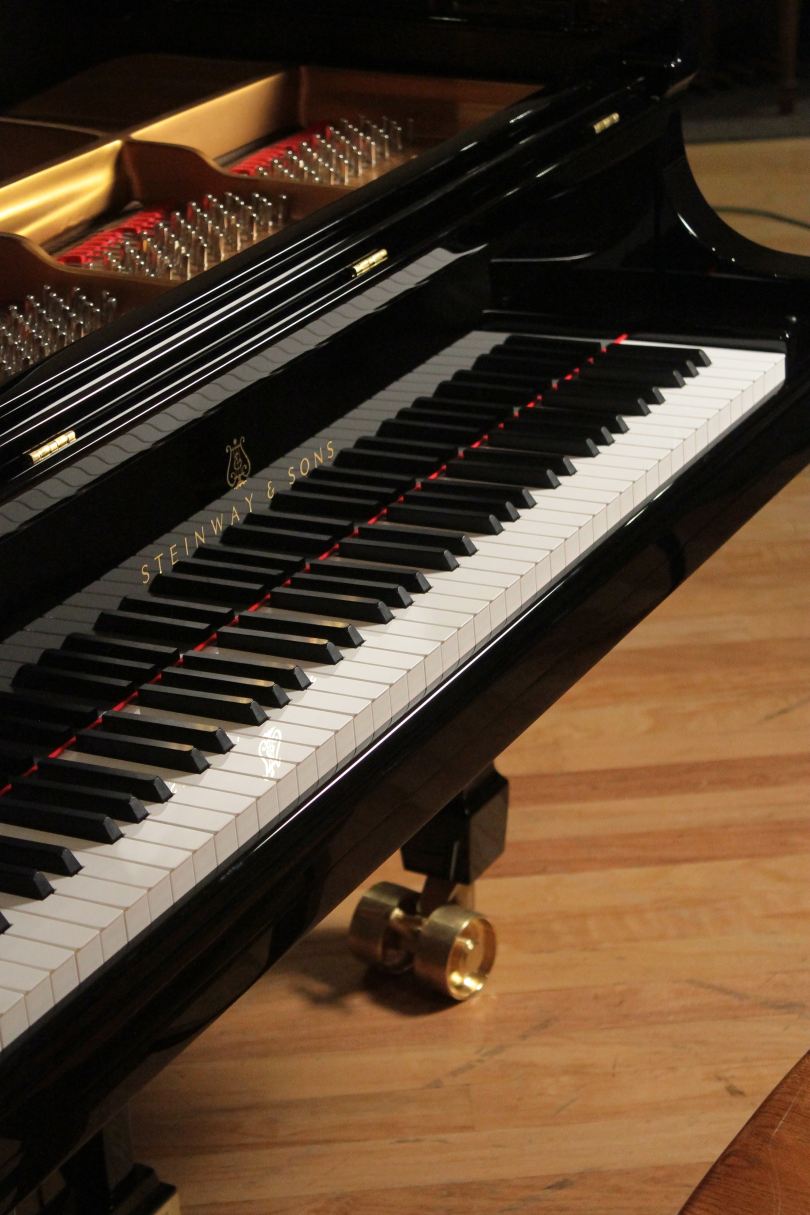
Piano Lessons
1
My teacher lies on the floor with a bad back
off to the side of the piano.
I sit up straight on the stool.
He begins by telling me that every key
is like a different room
and I am a blind man who must learn
to walk through all twelve of them
without hitting the furniture.
I feel myself reach for the first doorknob.
2
He tells me that every scale has a shape
and I have to learn how to hold
each one in my hands.
At home I practice with my eyes closed.
C is an open book.
D is a vase with two handles.
G flat is a black boot.
E has the legs of a bird.
3
He says the scale is the mother of the chords.
I can see her pacing the bedroom floor
waiting for her children to come home.
They are out at nightclubs shading and lighting
all the songs while couples dance slowly
or stare at one another across tables.
This is the way it must be. After all,
just the right chord can bring you to tears
but no one listens to the scales,
no one listens to their mother.
4
I am doing my scales,
the familiar anthems of childhood.
My fingers climb the ladder of notes
and come back down without turning around.
Anyone walking under this open window
would picture a girl of about ten
sitting at the keyboard with perfect posture,
not me slumped over in my bathrobe, disheveled,
like a white Horace Silver.
5
I am learning to play
“It Might As Well Be Spring”
but my left hand would rather be jingling
the change in the darkness of my pocket
or taking a nap on an armrest.
I have to drag him in to the music
like a difficult and neglected child.
This is the revenge of the one who never gets
to hold the pen or wave good-bye,
and now, who never gets to play the melody.
6
Even when I am not playing, I think about the piano.
It is the largest, heaviest,
and most beautiful object in this house.
I pause in the doorway just to take it all in.
And late at night I picture it downstairs,
this hallucination standing on three legs,
this curious beast with its enormous moonlit smile.
_________________________________
Maksim Mrvica plays Pirates of the Caribbean — Live at Mercedes-Benz Arena, Shanghai
Tutto mi prende la terra che mi possiede:
Il fiume d’improvviso adolescente,
La luce incespicando negli angoli,
Le sabbie ove arsi impaziente.
Tutto mi prende del medesimo triste amore
nel sapere che la vita dura poco,
E in essa pongo la speranza e il calore
Di quanta tenerezza rimane tra le dita.
Dicono che vi sono altri cieli e altre lune
E altri occhi densi di allegria,
Ma io appartengo a queste case, a queste vie,
A questo amore grondante malinconia.
Cançao breve
Tudo me prende à terra onde me dei:
O rio subitamente adolescente,
A luz tropeçando nas esquinas,
As areias onde ardi impaciente.
Tudo me prende do mesmo triste amor
Que há em saber que a vida pouco dura,
E nela ponho a esperança e o calor
De uns dedos com restos de ternura.
Dizem que há outros céus e outras luas
E outros olhos densos de alegria,
Mas eu sou destas casas, destas ruas,
Deste amor a escorrer melancolia.





 nonsolobiancoenero