Domani, da “Orientarsi con le stelle” Raymond Carver

Il fumo della sigaretta aleggia
nel salotto. Le luci della nave
laggiù al largo s’affievoliscono. Le stelle,
buchi bruciati nel cielo, s’inceneriscono, sì.
Ma va bene, è quello che devono fare.
Quelle luci che chiamiamo stelle.
Bruciare per un po’ e poi morire.
Io ho una fretta del diavolo. Vorrei
fosse già domani.
Ricordo che mia madre, Dio la benedica,
diceva: Non desiderare il domani.
Così sprechi la vita in desideri.
Eppure, lo desidero tanto
questo domani. Con tutti i suoi fronzoli.
Voglio che il sonno venga e se ne vada, tranquillo.
Come passare dalla portiera di una macchina
a un’altra. E poi svegliarmi!
E trovarmi domani nella stanza.
Ora sono più stanco di quanto riesca a dire.
La mia scodella è vuota. Ma è la mia, capite?
E io l’adoro.

(Traduzione di Riccardo Duranti e Francesco Durante)

Tomorrow

Cigarette smoke hanging on
in the living room. The ship’s lights
out on the water, dimming. The stars
burning holes in the sky. Becoming ash, yes.
But it’s all right, they’re supposed to do that.
Those lights we call stars.
Burn for a time and then die.
Me hell-bent. Wishing
it were tomorrow already.
I remember my mother, God love her,
saying, Don’t wish for tomorrow.
You’re wishing your life away.
Nevertheless, I wish
for tomorrow. In all its finery.
I want sleep to come and go, smoothly.
Like passing out of the door of one car
into another. And then to wake up!
Find tomorrow in my bedroom.
I’m more tired now than I can say.
My bowl is empty. But it’s my bowl, you see,
and I love it.

Il mondo del bambino, da “The Crescent Moon”, Rabindranath Tagore

Vorrei poter avere un angolo tutto per me nel cuore del mio bambino ed osservarlo nel suo vero mondo.
So che le stelle parlano con lui e il cielo si china sul suo viso per divertirlo con le sue frivole nubi, ed arcobaleni.
Ogni cosa che sembra muta e incapace di muoversi s’avvicina lentamente alla sua finestra recando fiabe e cesti pieni di lucenti giocattoli.
Vorrei poter viaggiare lungo la via che attraversa la mente del bambino, oltre tutti i confini; dove i messaggeri vanno errando tra i domìni di re senza storia; dove la Ragione fa aquiloni delle proprie leggi, e li lancia, e la Verità libera le azioni dalle sue catene.

(Traduzione di Maurizio Lipparini)

Baby’s World

I wish I could take a quiet corner in the heart of my baby’s very
own world.
I know it has stars that talk to him, and a sky that stoops
down to his face to amuse him with its silly clouds and rainbows.
Those who make believe to be dumb, and look as if they never
could move, come creeping to his window with their stories and with
trays crowded with bright toys.
I wish I could travel by the road that crosses baby’s mind,
and out beyond all bounds;
Where messengers run errands for no cause between the kingdoms
of kings of no history;
Where Reason makes kites of her laws and flies them, the Truth
sets Fact free from its fetters.

Luce, da “Poesie sparse” (1917/1936), Federico Garcia Lorca

È la magica ora intensa del tramonto.
Il monte si dissangua. La luce è bionda. Io
cammino sul sentiero con aria distrutta,
la fronte bassa e il cuore rosso.

Il poeta è l’ombra luminosa che cammina
con la pretesa di collegare gli uomini a Dio,
senza considerare che l’azzurro è un Sogno che vive
e la Terra un altro sogno che da tempo è morto.

L’azzurro che ammiriamo possiede la gran tristezza
di non prevedere mai dov’è la propria fine,
e Dio è la tristezza suprema ed impossibile
dal momento che il suo perché profondo neanche può parlare.

Il segreto di tutto non esiste. Le stelle
sono anime che vollero dare la scalata al mistero.
L’essenza del mistero le rese luce di pietra,
ma non riuscirono a introdursi nella sua Pace.

(Traduzione di Claudio Rendina)

Luz

Es la mágica hora sentida del ocaso.
El monte se desangra. La luz es rubia. Yo
marcho por el sendero con aire de fracaso,
apagada la frente y rojo el corazón.

El poeta es la sombra luminosa que marcha
pretendiendo enlazar a los hombres con Dios,
sin notar que el azul es un Sueño que vive
y la Tierra otro sueño que hace tiempo murió.

El azul que miramos tiene la gran tristeza
de no presentir nunca donde su fin está,
y Dios es la tristeza suprema e imposible
pues su porqué profundo tampoco puede hablar.

El secreto de todo no existe. Las estrellas
son almas que al misterio quisieron escalar.
La esencia del misterio las hizo luz de piedra,
pero no consiguieron internarse en su Paz.

Cos’era, da “Blizzard of One” (1998), Mark Strand

I
Era impossibile da immaginare, impossibile
da non immaginare; la sua azzurrezza, l’ombra che lasciava,
che cadeva, riempiva l’oscurità del proprio freddo,
il suo freddo che cadeva fuori da se stesso, fuori da qualsiasi idea
di sé descrivesse nel cadere; un qualcosa, una minuzia,
una macchia, un punto, un punto in un punto, un abisso infinito
di minuzia; una canzone, ma meno di una canzone, qualcosa che
affoga in sé, qualcosa che va, un’alluvione di suono, ma meno
di un suono; la sua fine, il suo vuoto,
il suo tenero, piccolo vuoto che colma la sua eco, e cade,
e si alza, inavvertito, e cade ancora, e così sempre,
e sempre perché, e solo perché, essendo stato, era…

II
Era l’inizio di una sedia;
era il divano grigio; era i muri,
il giardino, la strada di ghiaia; era il modo in cui
i ruderi di luna le crollavano sulla chioma.
Era quello, ed era altro ancora; era il vento che azzannava
gli alberi; era la congerie confusa di nubi, la bava
di stelle sulla riva. Era l’ora che pareva dire
che se sapevi in che punto esatto del tempo si era, non avresti
mai piu’ chiesto nulla. Era quello. Senz’altro era quello.
Era anche l’evento mai avvenuto – un momento tanto pieno
che quando se ne andò, come doveva, nessun dolore riusciva
a contenerlo. Era la stanza che pareva la stessa
dopo tanti anni. Era quello. Era il cappello
dimenticato da lei, la penna che lei lasciò sul tavolo.
Era il sole sulla mia mano. Era il caldo del sole. Era come
sedevo, come attendevo per ore, per giorni. Era quello. Solo quello.

(Traduzione di Damiano Abeni)

What it was

I
It was impossible to imagine, impossible
Not to imagine; the blueness of it, the shadow it cast,
Falling downward, filling the dark with the chill of itself,
The cold of it falling out of itself, out of whatever idea
Of itself it described as it fell; a something, a smallness,
A dot, a speck, a speck within a speck, an endless depth
Of smallness; a song, but less than a song, something drowning
Into itself, something going, a flood of sound, but less
Than a sound; the last of it, the blank of it,
The tender small blank of it filling its echo, and falling,
And rising unnoticed, and falling again, and always thus,
And always because, and only because, once having been, it was…

II
It was the beginning of a chair;
It was the gray couch; it was the walls,
The garden, the gravel road; it was the way
The ruined moonlight fell across her hair.
It was that, and it was more. It was the wind that tore
At the trees; it was the fuss and clutter of clouds, the shore
Littered with stars. It was the hour which seemed to say
That if you knew what time it really was, you would not
Ask for anything again. It was that. It was certainly that.
It was also what never happened – a moment so full
That when it went, as it had to, no grief was large enough
To contain it. It was the room that appeared unchanged
After so many years. It was that. It was the hat
She’d forgotten to take, the pen she left on the table.
It was the sun on my hand. It was the sun’s heat. It was the way
I sat, the way I waited for hours, for days. It was that. Just that.

Barchette di carta, da “Tagore Poesie d’Amore”, Rabindranath Tagore

Ogni giorno faccio galleggiare
le mie barche di carta a una a una
giù per la corrente del fiume.
Su di esse scrivo il mio nome
e il nome del villaggio dove vivo
in grandi lettere nere.
Io spero che un giorno qualcuno
in qualche paese straniero
le trovi, e sappia chi sono.
Carico le mie barchette con fiori
di shiuli, colti dal nostro giardino,
e spero che quei fiori del mattino
sian portati nel paese della notte.
Io varo le mie barchette di carta
e osservo nel cielo le nuvolette
che spiegano le loro bianche vele.
Non so quale mio compagno di giochi
su in cielo le mandi giù per l’aria
a gareggiare con le mie barchette!
Quando scende la notte affondo la faccia
nelle braccia, e comincio a sognare
che le mie barchette di carta
galleggiano sotto le stelle.
In esse viaggian le fate del sonno,
e il carico è cesti pieni di sogni.

(Traduzione di Girolamo Mancuso)

Paper Boats

Day by day I float my paper boats one by one down the running
stream.
In big black letters I write my name on them and the name of
the village where I live.
I hope that someone in some strange land will find them and
know who I am.
I load my little boats with shiuli flower from our garden, and
hope that these blooms of the dawn will be carried safely to land
in the night.
I launch my paper boats and look up into the sky and see the
little clouds setting thee white bulging sails.
I know not what playmate of mine in the sky sends them down
the air to race with my boats!
When night comes I bury my face in my arms and dream that my
paper boats float on and on under the midnight stars.
The fairies of sleep are sailing in them, and the lading ins
their baskets full of dreams.

Il ramo rubato, da “Los versos del Capitán”, Pablo Neruda

Nella notte entreremo
a rubare
un ramo fiorito.

Passeremo il muro,
nelle tenebre del giardino altrui,
due ombre nell’ombra.

Ancora non se n’é andato l’inverno,
e il melo appare
trasformato d’improvviso
in cascata di stelle odorose.
Nella notte entreremo
fino al suo tremulo firmamento,
e le tue piccole mani e le mie
ruberanno le stelle.

E cautamente
nella nostra casa,
nella notte e nell’ombra,
entrerà con i tuoi passi
il silenzioso passo del profumo
e con i piedi stellati
il corpo chiaro della Primavera.

La rama robada

En la noche entraremos
a robar
una rama florida.

Pasaremos el muro,
en las tinieblas del jardín ajeno,
dos sombras en la sombra.

Aún no se fue el invierno,
y el manzano aparece
convertido de pronto
en cascada de estrellas olorosas.
En la noche entraremos
hasta su tembloroso firmamento,
y tus pequeñas manos y las mías
robarán las estrellas.

Y sigilosamente,
a nuestra casa,
en la noche y en la sombra,
entrará con tus pasos
el silencioso paso del perfume
y con pies estrellados
el cuerpo claro de la primavera.

The Stolen Branch

In the night we shall go in
to steal
a flowering branch.

We shall climb over the wall
in the darkness of the alien garden,
two shadows in the shadow.

Winter is not yet gone,
and the apple tree appears
suddenly changed
into a cascade of fragrant stars.

In the night we shall go in
up to its trembling firmament,
and your little hands and mine
will steal the stars.

And silently,
to our house,
in the night and the shadow,
with your steps will enter
perfume’s silent step
and with starry feet
the clear body of spring.

C’era, da “Segunda antolojía poética”, Juan Ramon Jiménez

L’agnello belava dolcemente.
L’asino, tenero, si rallegrava
in un caldo richiamo.
Il cane latrava,
quasi parlando alle stelle…

Mi destai. Uscii. Vidi orme
celesti nel suolo
fiorito
come un cielo
capovolto.

Un alito tiepido e dolce
velava il bosco;
la luna andava declinando
in un tramonto d’oro e di seta,
che sembrava un ambito divino…

Il mio petto palpitava,
come se il cuore avesse avuto vino…

Aprii la stalla per vedere se
era li.
C’era!

Aldea

El cordero balaba dulcemente.
El asno, tierno, se alegraba
en un llamar caliente.
El perro ladreaba,
hablando casi a las estrellas…

Me desvelé, Salí. Vi huellas
celestes por el suelo
florecido
como un cielo
invertido.

Un vaho tibio y blando
velaba la arboleda;
la luna iba declinando
en un ocaso de oro y seda,
que parecía un ámbito divino…

Mi pecho palpitaba,
como si el corazón tuviese vino…

Abrí el establo a ver si estaba
El allí.
¡Estaba!

Giovane, da “All My Pretty Ones”, Anne Sexton

Mille porte fa
quando ero una ragazzina solitaria
in un’enorme casa con quattro
garage e se ben ricordo
era estate,
di notte mi sdraiavo in giardino,
il trifoglio raggrinzito sotto di me,
le sagge stelle distese sopra di me,
la finestra di mia madre un imbuto
da cui usciva un calore giallo,
la finestra di mio padre, socchiusa,
un occhio dove passa chi dorme,
e le assi della casa
erano lisce e bianche come cera
e probabilmente milioni di foglie
navigavano come vele sui loro strani gambi
mentre i grilli ticchettavano all’unisono
e io, nel mio corpo nuovo di zecca,
non ancora di donna,
facevo domande alle stelle
e credevo che Dio potesse veramente vedere
il calore e la luce colorata,
i gomiti, le ginocchia, i sogni, la buonanotte.

Young

A thousand doors ago,
when I was a lonely kid
in a big house with four
garages and it was summer
as long as I could remember,
I lay on the lawn at night,
clover wrinkling under me,
the wise stars bedding over me,
my mother’s window a funnel
of yellow heat running out,
my father’s window, half shut,
an eye where sleepers pass,
and the boards of the house
were smooth and white as wax
and probably a million leaves
sailed on their strange stalks
as the crickets ticked together
and I, in my brand new body,
which was not a woman’s yet,
told the stars my questions
and thought God could really see
the heat and the painted light,
elbows, knees, dreams, goodnight.

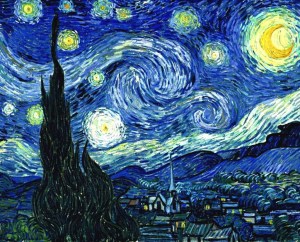
Notte stellata, Anne Sexton

La città non esiste
se non dove un albero dai capelli
neri scivola via, come una donna
annegata nel cielo caldo. Tace,
la città. Bolle la notte, con dieci
e una stella. Oh notte stellata,
stellata notte! È così che voglio
morire.

Si muove. Sono tutti quanti vivi.
Quando la luna rompe le catene
arancioni che la legano e spruzza
bambini dai suoi occhi, come un dio,
il vecchio serpente, senza esser visto
divora le stelle. Oh stellata notte,
notte stellata! È così che voglio
morire:

in questa strisciante bestia notturna,
risucchiata tutta dentro nel grande
drago, separata
dalla mia vita senza una bandiera,
senza pancia
né grido.

The Starry Night

The town does not exist
except where one black-haired tree slips
up like a drowned woman into the hot sky.
The town is silent. The night boils with eleven stars.
Oh starry night! This is how
I want to die.

It moves. They are all alive.
Even the moon bulges in its orange irons
to push children, like a god, from its eye.
The old unseen serpent swallows up the stars.
Oh starry starry night! This is how
I want to die:

into that rushing beast of the night,
sucked up by that great dragon, to split
from my life with no flag,
no belly,
no cry.

_________________________________________

“That does not keep me from having a terrible need of – shall I say the word – religion. Then I go out at night to paint the stars.”
– Vincent Van Gogh in a letter to his brother

notte stellata Van Gogh
Starry Night – Vincent Van Gogh

Magnificat, da “Poesias de Álvaro de Campos” (1933), Fernando Pessoa

Quando passerà questa notte interna, l’universo,
e io, l’anima mia, avrò il mio giorno?
Quando mi desterò dall’essere desto?
Non so. Il sole brilla alto:
impossibile guardarlo.
Le stelle ammiccano fredde:
impossibile contarle.
Il cuore batte estraneo:
impossibile ascoltarlo.
Quando finirà questo dramma senza teatro,
o questo teatro senza dramma,
e potrò tornare a casa?
Dove? Come? Quando?
Gatto che mi fissi con occhi di vita, chi hai là in fondo?
Si, sì, è lui!
Lui, come Giosuè, farà fermare il sole e io mi sveglierò;
e allora sarà giorno.
Sorridi nel sonno, anima mia!
Sorridi anima mia: sarà giorno!

(Traduzione di Antonio Tabucchi)

Magnificat

Quando é que passará esta noite interna, o universo,
E eu, a minha alma, terei o meu dia?
Quando é que despertarei de estar acordado?
Não sei. O sol brilha alto,
Impossível de fitar.
As estrelas pestanejam frio,
Impossíveis de contar.
O coração pulsa alheio,
Impossível de escutar.
Quando é que passará este drama sem teatro,
Ou este teatro sem drama,
E recolherei a casa?
Onde? Como? Quando?
Gato que me fitas com olhos de vida, Quem tens lá no fundo?
É Esse! É esse!
Esse mandará como Josué parar o sol e eu acordarei;
E então será dia.
Sorri, dormindo, minha alma!
Sorri, minha alma: será dia!

Magnificat

When will this inner night – the universe – end
And I – my soul – have my day?
When will I wake up from being awake?
I don’t know. The sun shines on high
And cannot be looked at.
The stars coldly blink
And cannot be counted.
The heart beats aloofly
And cannot be heard.
When will this drama without theater
– Or this theater without drama – end
So that I can go home?
Where? How? When?
O cat staring at me with eyes of life, Who lurks in your depths?
It’s Him! It’s him!
Like Joshua he’ll order the sun to stop, and I’ll wake up,
And it will be day.
Smile, my soul, in your slumber!
Smile, my soul: it will be day!

(Translation: 2006, Richard Zenith
From: A Little Larger Than the Entire Universe: Selected Poems)