L’amore è un luogo, Edward Estlin Cummings

L’amore è un luogo
e in questo luogo di
amore si muovono
(con luminosità e pace)
tutti i luoghi

il sì è un mondo
e in questo mondo di
sì vivono
(sagacemente rannicchiati)
tutti i mondi.

love is a place

love is a place
& through this place of
love move
(with brightness of peace)
all places

yes is a world
& in this world of
yes live
(skillfully curled)
all worlds

“love is a place” by E.E. Cummings from Complete Poems 1904-1962, edited by George James Firmage

Completamente, da “Viole nere”, Tess Gallagher

A quei tempi il mio spirito un’ape –
il mondo, un gigantesco ronzio che sbavava
dolcezza. Dolce da scoppiare.
Amore davanti. Amore sotto di me.

Ma soprattutto, l’estasi contraria
mi rimbalzava dentro – lo sterile fracasso
che l’amore alla fine fa mentre s’avvia al silenzio.

Completamente – esser distrutta nel regno
dei fiori. Completamente fradicia, trafitta
in un vuoto di pace.
Senza ricordare carezza esterna
o tenera occhiata.

È così che succede scontrandosi con l’essenza
senza volto del cuore. Non ci sono contorni. Solo
un invivibile carminio. Solo l’affollato braille
di un’impavida premonizione
che porge goffa l’altra guancia.

(Traduzione di Francesco Duranti)

Utterly

My spirit was a bee in those days –
the world one gigantic buzz, drooling
sweetness. Sweet unto bursting.
Love ahead. Love under me.

But most of all, that contrary ecstasy
ricocheting inside – the barren racket
love finally makes on its way to silence.

Utterly – to be destroyed in the kingdom
of flowers. Utterly sodden, sundered
into a blank of peace.
Not to remember outside caress
or tender look.

It’s like that against the facelessness
of the heart. No contours. Only
unlivable crimson. Only the clustered braille
of a fearless premonition
fumbling the turned cheek.

Dharma, da “A vela in solitaria intorno alla stanza” (2013), Billy Collins

Il modo in cui la mia cagnetta
trotta fuori dalla porta ogni mattina
senza un cappello o un ombrello,
senza neanche un soldo
né le chiavi della cuccia
non manca mai di riempirmi la ciotola del cuore
di lattea ammirazione.

Chi può offrire miglior esempio
di una vita priva di orpelli –
Thoreau nella sua capanna senza tende
con un solo piatto, un solo cucchiaio?
Gandhi col bastone e gli occhialini?

Ecco che lei se ne va nel mondo reale
con nient’altro che il mantello marrone
e un modesto collare azzurro,
seguendo solo il suo naso bagnato,
portali gemelli del suo costante respiro,
seguita solo dal pennacchio della sua coda.

Se solo non cacciasse via il gatto
ogni mattina
e mangiasse tutto il suo cibo
quale modello di autocontrollo sarebbe,
quale esempio di distacco mondano.
Se solo non desiderasse così tanto
un massaggio dietro le orecchie,
non fosse così acrobatica nel dare il benvenuto,
se solo io non fossi il suo dio.

(Traduzione di Franco Nasi)

Dharma

The way the dog trots out the front door
every morning
without a hat or an umbrella,
without any money
or the keys to her dog house
never fails to fill the saucer of my heart
with milky admiration.

Who provides a finer example
of a life without encumbrance—
Thoreau in his curtainless hut
with a single plate, a single spoon?
Ghandi with his staff and his holy diapers?

Off she goes into the material world
with nothing but her brown coat
and her modest blue collar,
following only her wet nose,
the twin portals of her steady breathing,
followed only by the plume of her tail.

If only she did not shove the cat aside
every morning
and eat all his food
what a model of self-containment she would be,
what a paragon of earthly detachment.
If only she were not so eager
for a rub behind the ears,
so acrobatic in her welcomes,
if only I were not her god.

from “Sailing Alone Around the Room”

Valzer, da “Dalla vita degli oggetti” (2012), Adam Zagajewski

Sono così sgargianti i giorni, così chiari,
che la polvere bianca della disattenzione
copre persino le rare esili palme.
Le serpi scivolano silenziose nelle vigne,
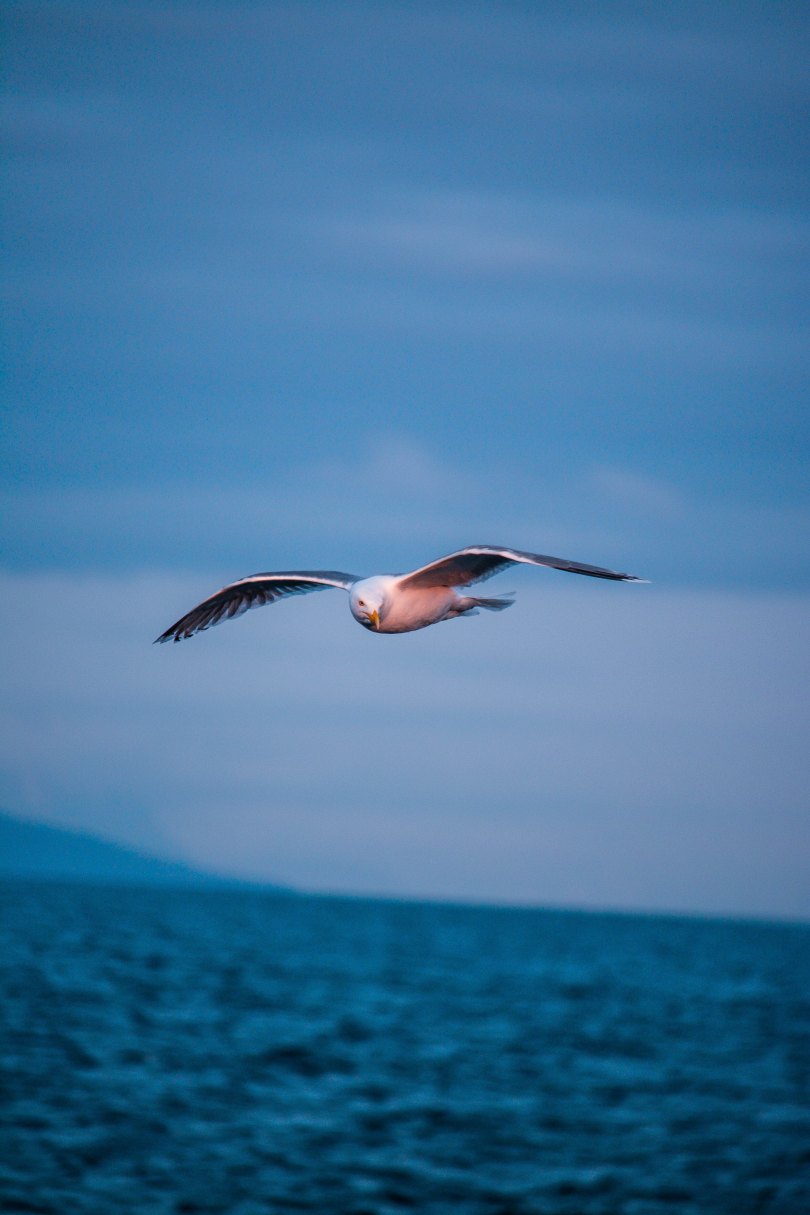
ma alla sera il mare si fa cupo e i gabbiani
sospesi nell’aria si muovono appena,
punteggiatura di un più alto scritto.
Sulle tue labbra una goccia di vino.
Le montagne calcaree all’orizzonte si dissolvono
lente mentre una stella appare.
La notte, in piazza, un’orchestra di marinai
in uniformi bianche immacolate
suona un valzer di Šostakovič; piangono
i bimbi, come se intuissero
di cosa parla quella musica allegra.
Siamo stati rinchiusi nella scatola del mondo.
L’amore ci renderà liberi, il tempo ci ucciderà.

(Traduzione di Krystyna Jaworska)

Little Waltz

The days are so vivid, so bright
that even the slim, sparse palms
are covered in the white dust of neglect.
Serpents in the vineyards slither softly,
but the evening sea grows dark and,
suspended overhead like punctuation
in the highest script, the seagulls barely stir.
A drop of wine’s inscribed upon your lips.
The limestone hills slowly melt
on the horizon and a star appears.
At night on the square an orchestra of sailors
dressed in spotless white
plays a little waltz by Shostakovich; small children
cry as if they’d guessed
what the merry music’s really saying.
We’ve been locked in the world’s box,
love sets us free, time kills us.

(Translated by Clare Cavanagh)

_______________________________________

D. Shostakovich – Waltz No. 2 from the Jazz Suite No. 2 Cracow Opera House, March 2012

Lo spirito ama vestirsi così, da “Dream Work” (1998), Mary Oliver

Lo spirito ama vestirsi così:
dieci dita delle mani, dieci dita dei piedi,
le spalle e tutto il resto.
Di notte tra i rami bui,
di giorno tra i rami blu del mondo.
Potrebbe fluttuare, naturalmente,
ma ha preferito piombare nella materia grezza.
Eterea e informe cosa,
ha bisogno della metafora del corpo,
calce e appetito,
i fluidi oceanici;
ha bisogno del mondo della materia,
l’istinto e l’immaginazione,
e dell’oscuro abbraccio del tempo,
della dolcezza e della concretezza
per essere capita,
per essere di più
di luce pura
che brucia dove nessuno è.
Così ci penetra,
la mattina
risplendendo nel riposo del corpo

come punta di fulmine;
e di notte
quando illumina il misterioso e profondo
inabissarsi del corpo,
come una stella.

Poem (the spirit likes to dress up)

The spirit
likes to dress up like this:
ten fingers,
ten toes,

shoulders, and all the rest
at night
in the black branches,
in the morning

in the blue branches
of the world.
It could float, of course,
but would rather

plumb rough matter.
Airy and shapeless thing,
it needs
the metaphor of the body,

lime and appetite,
the oceanic fluids;
it needs the body’s world,
instinct

and imagination
and the dark hug of time,
sweetness
and tangibility,

to be understood,
to be more than pure light
that burns
where no one is –

so it enters us –
in the morning
shines from brute comfort
like a stitch of lightning;

and at night
lights up the deep and wondrous
drownings of the body
like a star.

Abbiamo fame di tenerezza, Alda Merini

Abbiamo fame di tenerezza,
in un mondo dove tutto abbonda
siamo poveri di questo sentimento
che è come una carezza
per il nostro cuore
abbiamo bisogno di questi piccoli gesti
che ci fanno stare bene,
la tenerezza
è un amore disinteressato e generoso,
che non chiede nient’altro
che essere compreso e apprezzato.

Prova a cantare il mondo mutilato, da “Dalla vita degli oggetti” (2012), Adam Zagajewski

Prova a cantare il mondo mutilato.
Ricorda le lunghe giornate di giugno
e le fragole, le gocce di vino rosé.
Le ortiche che metodiche ricoprivano
le case abbandonate da chi ne fu cacciato.
Devi cantare il mondo mutilato.
Hai guardato navi e barche eleganti;
attesi da un lungo viaggio,
o soltanto da un nulla salmastro.
Hai visto i profughi andare verso il nulla,
hai sentito i carnefici cantare allegramente.
Dovresti celebrare il mondo mutilato.
Ricorda quegli attimi, quando eravate insieme
in una stanza bianca e la tenda si mosse.
Torna col pensiero al concerto, quando la musica esplose.
D’autunno raccoglievi ghiande nel parco
e le foglie volteggiavano sulle cicatrici della terra.
Canta il mondo mutilato
e la piccola penna grigia persa dal tordo,
e la luce delicata che erra, svanisce
e ritorna.

(Traduzione di Krystyna Jaworska)

Try to Praise the Mutilated World

Try to praise the mutilated world.
Remember June’s long days,
and wild strawberries, drops of rosé wine.
The nettles that methodically overgrow
the abandoned homesteads of exiles.
You must praise the mutilated world.
You watched the stylish yachts and ships;
one of them had a long trip ahead of it,
while salty oblivion awaited others.
You’ve seen the refugees heading nowhere,
you’ve heard the executioners sing joyfully.
You should praise the mutilated world.
Remember the moments when we were together
in a white room and the curtain fluttered.
Return in thought to the concert where music flared.
You gathered acorns in the park in autumn
and leaves eddied over the earth’s scars.
Praise the mutilated world
and the gray feather a thrush lost,
and the gentle light that strays and vanishes
and returns.

(Translated by Clare Cavanagh)

Il mondo del bambino, da “The Crescent Moon”, Rabindranath Tagore

Vorrei poter avere un angolo tutto per me nel cuore del mio bambino ed osservarlo nel suo vero mondo.
So che le stelle parlano con lui e il cielo si china sul suo viso per divertirlo con le sue frivole nubi, ed arcobaleni.
Ogni cosa che sembra muta e incapace di muoversi s’avvicina lentamente alla sua finestra recando fiabe e cesti pieni di lucenti giocattoli.
Vorrei poter viaggiare lungo la via che attraversa la mente del bambino, oltre tutti i confini; dove i messaggeri vanno errando tra i domìni di re senza storia; dove la Ragione fa aquiloni delle proprie leggi, e li lancia, e la Verità libera le azioni dalle sue catene.

(Traduzione di Maurizio Lipparini)

Baby’s World

I wish I could take a quiet corner in the heart of my baby’s very
own world.
I know it has stars that talk to him, and a sky that stoops
down to his face to amuse him with its silly clouds and rainbows.
Those who make believe to be dumb, and look as if they never
could move, come creeping to his window with their stories and with
trays crowded with bright toys.
I wish I could travel by the road that crosses baby’s mind,
and out beyond all bounds;
Where messengers run errands for no cause between the kingdoms
of kings of no history;
Where Reason makes kites of her laws and flies them, the Truth
sets Fact free from its fetters.

Giorno d’estate, Mary Oliver

Chi ha fatto il mondo?
Chi ha fatto il cigno e l’orso bruno?
Chi ha fatto la cavalletta?
Questa cavalletta, intendo, quella che è saltata fuori
dall’erba,
che sta mangiandomi lo zucchero in mano,
che muove le mandibole avanti e indietro invece che in su e in giù
e si guarda attorno con i suoi occhi enormi e complicati.
Ora solleva le zampine chiare e si pulisce il muso, con cura.
Ora apre le ali di scatto e vola via.
Non so esattamente che cosa sia una preghiera;
so prestare attenzione, so cadere nell’erba,
inginocchiarmi nell’erba,
so starmene beatamente in ozio, so andare a zonzo nei prati,
è quel che oggi ho fatto tutto il giorno.
Dimmi, che altro avrei dovuto fare?
Non è vero che tutto muore prima o poi, fin troppo presto?
Dimmi, che cosa pensi di fare
della tua unica vita, selvaggia e preziosa?

The Summer Day

Who made the world?
Who made the swan, and the black bear?
Who made the grasshopper?
This grasshopper, I mean– the one who has flung herself out of the grass,
the one who is eating sugar out of my hand,
who is moving her jaws back and forth instead of up and down–
who is gazing around with her enormous and complicated eyes.
Now she lifts her pale forearms and thoroughly washes her face.
Now she snaps her wings open, and floats away.
I don’t know exactly what a prayer is.
I do know how to pay attention, how to fall down
into the grass, how to kneel down in the grass,
how to be idle and blessed, how to stroll through the fields,
which is what I have been doing all day.
Tell me, what else should I have done?
Doesn’t everything die at last, and too soon?
Tell me, what is it you plan to do
with your one wild and precious life?

Mary Oliver, The House Light, Beacon Press, Boston, 1990

Lo scoubidou, da “The Trouble with Poetry” (2005), Billy Collins

L’altro giorno mentre rimbalzavo lentamente
tra le pareti azzurre di questa stanza,
saltando dalla macchina da scrivere al piano,
dalla libreria a una busta caduta sul pavimento,
mi sono trovato nella sezione S del dizionario
dove i miei occhi sono caduti sulla parola Scoubidou.

Nessun biscotto sgranocchiato da un romanziere francese
avrebbe spedito qualcuno più in fretta nel passato –
un passato dove io stavo seduto a un tavolo in un campeggio
accanto a un lago profondo dell’Adirondack
e imparavo a intrecciare con strisce sottili di plastica
uno scoubidou, un regalo per mia madre.

Non avevo mai visto nessuno usare uno scoubidou
né indossarne uno, se è così che si usano,
ma questo non mi trattenne dall’incrociare
filo con filo, e poi di nuovo,
fino a farne uno scoubidou
quadrato, bianco e rosso, per mia madre.

Lei mi diede la vita e il latte dal seno,
io le diedi uno scoubidou.
Si prendeva cura di me, quand’ero a letto ammalato:
mi avvicinava alle labbra cucchiai di medicine,
mi appoggiava alla fronte freddi panni bagnati,
poi mi portava fuori alla luce delicata;

e mi insegnò a camminare e nuotare,
io in cambio le regalai uno scoubidou.
Ecco qui migliaia di pasti, disse,
ed ecco i vestiti e una buona scuola.
Ed ecco il tuo scoubidou, le risposi,
che ho fatto con l’aiuto dell’istruttore.

Ecco un corpo che respira e un cuore che batte,
gambe, ossa, denti forti,
e due occhi chiari per leggere il mondo, sussurrò.
Ed ecco, dissi, lo scoubidou, che ho fatto in campeggio.
Ed ecco, vorrei dirle ora,
un dono più piccolo: non l’antica verità

che non si può mai ripagare una madre,
ma la triste confessione che quando lei prese
lo scoubidou a due colori dalle mie mani,
ero certo come certo può essere un bambino
che quell’oggetto inutile e senza valore, che avevo intrecciato
per pura noia, bastava per pareggiare i conti.

(Traduzione di Franco Nasi)

The Lanyard

The other day as I was ricocheting slowly
off the pale blue walls of this room,
bouncing from typewriter to piano,
from bookshelf to an envelope lying on the floor,
I found myself in the L section of the dictionary
where my eyes fell upon the word lanyard.

No cookie nibbled by a French novelist
could send one more suddenly into the past —
a past where I sat at a workbench at a camp
by a deep Adirondack lake
learning how to braid thin plastic strips
into a lanyard, a gift for my mother.

I had never seen anyone use a lanyard
or wear one, if that’s what you did with them,
but that did not keep me from crossing
strand over strand again and again
until I had made a boxy
red and white lanyard for my mother.

She gave me life and milk from her breasts,
and I gave her a lanyard.
She nursed me in many a sickroom,
lifted teaspoons of medicine to my lips,
set cold face-cloths on my forehead,
and then led me out into the airy light

and taught me to walk and swim,
and I, in turn, presented her with a lanyard.
Here are thousands of meals, she said,
and here is clothing and a good education.
And here is your lanyard, I replied,
which I made with a little help from a counselor.

Here is a breathing body and a beating heart,
strong legs, bones and teeth,
and two clear eyes to read the world, she whispered,
and here, I said, is the lanyard I made at camp.
And here, I wish to say to her now,
is a smaller gift-not the archaic truth

that you can never repay your mother,
but the rueful admission that when she took
the two-tone lanyard from my hands,
I was as sure as a boy could be
that this useless, worthless thing I wove
out of boredom would be enough to make us even.