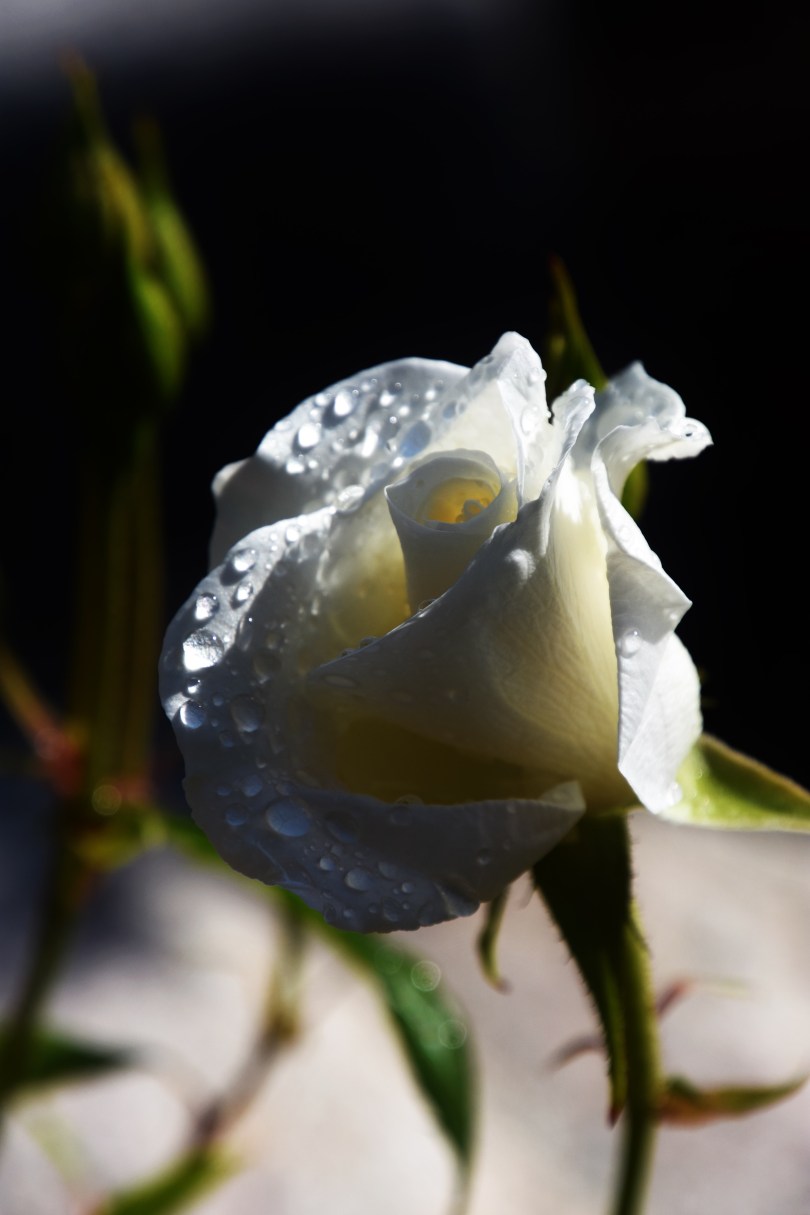
E’ oggi: tutto l’ieri andò cadendo, da “Cento sonetti d’amore”, Pablo Neruda

E’ oggi: tutto l’ieri andò cadendo
entro dita di luce e occhi di sogno,
domani arriverà con passi verdi:
nessuno arresta il fiume dell’aurora.
Nessuno arresta il fiume delle tue mani,
gli occhi dei tuoi sogni, beneamata,
sei tremito del tempo che trascorre
tra luce verticale e sole cupo,
e il cielo chiude su te le sue ali
portandoti, traendoti alle mie braccia
con puntuale, misteriosa cortesia.
Per questo canto il giorno e la luna,
il mare, il tempo, tutti i pianeti,
la tua voce diurna e la tua pelle notturna.

Es hoy: todo el ayer se fue cayendo

Es hoy: todo el ayer se fue cayendo
entre dedos de luz y ojos de sueño,
mañana llegará con pasos verdes:
nadie detiene el río de la aurora.
Nadie detiene el río de tus manos,
los ojos de tu sueño, bienamada,
eres temblor del tiempo que transcurre
entre luz vertical y sol sombrío,
y el cielo cierra sobre ti sus alas
llevándote y trayéndote a mis brazos
con puntual, misteriosa cortesía:
Por eso canto al día y a la luna,
al mar, al tiempo, a todos los planetas,
a tu voz diurna y a tu piel nocturna.

Il tavolo accanto, Konstantinos Kavafis

Avrà sì e no ventidue anni.
Eppure sono certo che, quasi altrettanti
anni fa, questo stesso corpo io l’ho goduto.

Non è affatto esaltazione erotica.
Solo da poco sono entrato nel caffè:
non ho avuto il tempo di bere molto.
Lo stesso corpo io l’ho goduto.

E se non ricordo dove – la mia amnesia che significa?

Ah, ora, ecco, che si è seduto al tavolo accanto
riconosco ogni mossa che fa – e sotto i vestiti
lo rivedo nudo, quel corpo amato.

The Next Table

He must be barely twenty-two years old—
yet I’m certain that almost that many years ago
I enjoyed the very same body.

It isn’t erotic fever at all.
And I’ve been in the casino for a few minutes only,
so I haven’t had time to drink a great deal.
I enjoyed that very same body.

And if I don’t remember where, this one lapse of memory
doesn’t mean a thing.

There, now that he’s sitting down at the next table,
I recognize every motion he makes—and under his clothes
I see again the limbs I loved, naked.

(Translated by Edmund Keeley and Philip Sherrard)

C’incontrammo come scintille, Emily Dickinson

C’incontrammo come Scintille – Divergenti Selci
Spinte per varie – sparse vie –
Ci separammo come se il Centro della Selce
Fosse stato spaccato da un’Ascia –
Sostenuti dalla Luce che avevamo generato
Prima di avvertire il Buio –
Che distinguemmo dal contrasto fra esso
E quell’eterea Scintilla.

(Trad. di Giuseppe Ierolli)

We met as Sparks – Diverging Flints

We met as Sparks – Diverging Flints
Sent various – scattered ways –
We parted as the Central Flint
Were cloven with an Adze –
Subsisting on the Light We bore
Before We felt the Dark –
We knew by change between itself
And that etherial Spark.

I bimbi di Extremadura, da “El poeta en la calle”, Rafael Alberti

I bimbi di Extremadura
vanno scalzi.
Chi ha rubato le loro scarpe?
Li ferisce il caldo e il freddo.
Chi ha strappato i loro vestiti?
La pioggia
bagna loro il letto e il sonno.
Chi demolì la loro casa?
Non sanno
i nomi delle stelle.
Chi chiuse la loro scuola?
I bimbi di Extremadura
sono seri.
Chi fu che rubò i loro giochi?

Los niños de Extremadura

Los niños de Extremadura
van descalzos.
¿Quién les robó los zapatos?
Les hiere el calor y el frío.
¿Quién les rompió los vestidos?
La lluvia
les moja el sueño y la cama.
¿Quién les derribó la casa?
No saben
los nombres de las estrellas.
¿Quién les cerró las escuelas?
Los niños de Extremadura
son serios.
¿Quién fue el ladrón de sus juegos?

Uve di mare, Derek Walcott

Quella vela piegata dalla luce,
stanca d’isole,
una goletta che batte il Mar dei Caraibi

per ritornare, potrebbe essere Odisseo
diretto a casa attraverso l’Egeo:
quel desiderio di padre e di marito,

sotto l’aspro livore della vecchiezza,
è come l’adultero che sente il nome di Nausicaa
in ogni grido di gabbiano.

E questo non assicura la pace. L’antica guerra
tra ossessione e responsabilità
non può finire ed è la stessa

per il naufrago e per chi sul lido
ora infila i piedi nei sandali per rientrare
da quando Troia ha spirato l’ultima fiamma

e il macigno del cieco ciclope ha alzato le acque
dalle cui ondate i grandiosi esametri giungono
alle conclusioni dell’esausta risacca.

I classici possono consolare. Ma non abbastanza.

Sea Grapes

That sail which leans on light,
tired of islands,
a schooner beating up the Caribbean

for home, could be Odysseus,
home-bound on the Aegean;
that father and husband’s

longing, under gnarled sour grapes, is like
the adulterer hearing Nausicaa’s name in
every gull’s outcry.
This brings nobody peace. The ancient war
between obsession and responsibility will
never finish and has been the same

for the sea-wanderer or the one on shore now
wriggling on his sandals to walk home, since
Troy sighed its last flame,

and the blind giant’s boulder heaved the trough from
whose groundswell the great hexameters come to the
conclusions of exhausted surf.

The classics can console. But not enough.

E’ una brezza leggera, da “Poemas”, Fernando Pessoa

E’ una brezza leggera
che l’aria un momento ebbe
e che passa senza avere
quasi avuto bisogno di essere.

Chi amo non esiste.
Vivo indeciso e triste.
Chi volli essere già mi dimentica.
Chi sono non mi conosce.

E in mezzo a questo l’aroma
portato dalla brezza, mi affiora
un momento alla coscienza
come una confidenza.

É uma brisa leve

É uma brisa leve
Que o ar um momento teve
E que passa sem ter
Quase por tudo ser.

Quem amo não existe.
Vivo indeciso e triste.
Quem quis ser já me esquece
Quem sou não me conhece.

E em meio disto o aroma
Que a brisa traz me assoma
Um momento à consciência
Como uma confidência.

Il minacciato, da “El oro de los tigres”, Jorge Luis Borges

È l’amore. Dovrò nascondermi o fuggire.
Crescono le mura delle sue carceri, come in un incubo atroce.
La bella maschera è cambiata, ma come sempre è l’unica. A cosa mi serviranno i miei talismani: l’esercizio delle lettere, la vaga erudizione, lo studio delle parole che l’aspro Nord usò per cantare i suoi mari e le sue spade, la serena amicizia, le gallerie della Biblioteca, le cose comuni, le abitudini, il giovane amore di mia madre, l’ombra militare dei miei morti, la notte intemporale, il sapore del sonno?
Stare con te o non stare con te è la misura del mio tempo.
Già la brocca si rompe sulla fontana, già l’uomo si alza alla voce dell’uccello, già sono oscure sagome quelli che guardavano dietro le finestre, ma l’ombra non ha portato la pace.
È, lo so, l’amore: l’ansia e il sollievo di sentire la tua voce, l’attesa e la memoria, l’orrore di vivere nel tempo successivo.
È l’amore con le sue mitologie, con le sue piccole magie inutili.
C’è un angolo di strada dove non oso passare.
Già gli eserciti mi accerchiano, le orde.
(Questa stanza è irreale: lei non l’ha vista).
Il nome di una donna mi denuncia.
Mi fa male una donna in tutto il corpo.

El amanezado

Es el amor. Tendré que cultarme o que huir.
Crecen los muros de su cárcel, como en un sueño atroz.
La hermosa máscara ha cambiado, pero como siempre es la única.
¿De qué me servirán mis talismanes: el ejercicio de las letras,
la vaga erudición, el aprendizaje de las palabras que usó el áspero Norte para cantar sus mares y sus espadas,
la serena amistad, las galerías de la biblioteca, las cosas comunes,
los hábitos, el joven amor de mi madre, la sombra militar de mis muertos, la noche intemporal, el sabor del sueño?
Estar contigo o no estar contigo es la medida de mi tiempo.
Ya el cántaro se quiebra sobre la fuente, ya el hombre se
levanta a la voz del ave, ya se han oscurecido los que miran por las ventanas, pero la sombra no ha traído la paz.
Es, ya lo sé, el amor: la ansiedad y el alivio de oír tu voz, la espera y la memoria, el horror de vivir en lo sucesivo.
Es el amor con sus mitologías, con sus pequeñas magias inútiles.
Hay una esquina por la que no me atrevo a pasar.
Ya los ejércitos me cercan, las hordas.
(Esta habitación es irreal; ella no la ha visto.)
El nombre de una mujer me delata.
Me duele una mujer en todo el cuerpo.

Un uccello azzurro, Charles Bukowski

Nel mio cuore c’è un uccello azzurro che
vuole uscire,
ma con lui sono inflessibile,
gli dico: rimani dentro, non voglio che
nessuno ti veda.

Nel mio cuore c’è un uccello azzurro che
vuole uscire
ma gli verso addosso whisky e aspiro
il fumo delle sigarette
e le puttane e i baristi
e i commessi del droghiere
non sanno che lì dentro c’è lui.

Nel mio cuore c’è un uccello azzurro che
vuole uscire
ma io con lui sono inflessibile,
gli dico: rimani giù, mi vuoi fare
andar fuori di testa?
vuoi mandare all’aria tutto il mio lavoro?
vuoi far saltare le vendite dei miei libri in Europa?

Nel mio cuore c’è un uccello azzurro che
vuole uscire
solo di notte qualche volta
quando dormono tutti.
Gli dico: lo so che ci sei,
non essere triste
poi lo rimetto a posto,

ma lui lì dentro un pochino canta,
mica l’ho fatto davvero morire,
dormiamo insieme così
col nostro patto segreto
ed è così grazioso da far piangere
un uomo, ma io non piango,
e voi?

Bluebird

there’s a bluebird in my heart that
wants to get out
but I’m too tough for him,
I say, stay in there, I’m not going
to let anybody see
you.
there’s a bluebird in my heart that
wants to get out
but I pour whiskey on him and inhale
cigarette smoke
and the ****s and the bartenders
and the grocery clerks
never know that
he’s
in there.

there’s a bluebird in my heart that
wants to get out
but I’m too tough for him,
I say,
stay down, do you want to mess
me up?
you want to screw up the
works?
you want to blow my book sales in
Europe?
there’s a bluebird in my heart that
wants to get out
but I’m too clever, I only let him out
at night sometimes
when everybody’s asleep.
I say, I know that you’re there,
so don’t be
sad.
then I put him back,
but he’s singing a little
in there, I haven’t quite let him
die
and we sleep together like
that
with our
secret pact
and it’s nice enough to
make a man
weep, but I don’t
weep, do
you?

Poesia animata  da Monika Umba, studentessa della Cambridge School of Art

Il mio fiume corre a te, Emily Dickinson

Il mio Fiume corre a Te –
Azzurro Mare – Mi accoglierai?

Il mio Fiume aspetta risposta –
Oh Mare – sii benigno!

Ti porterò Ruscelli
Da umbratili nascondigli –

Di’ Mare – mi prendi?

(Trad. di Giuseppe Ierolli)

My River runs to Thee

My River runs to Thee –
Blue Sea – Wilt welcome me?

My River waits reply –
Oh Sea – look graciously!

I’ll fetch thee Brooks
From spotted nooks –

Say Sea – take me?

Io sono verticale, da “L’altro sguardo”, Sylvia Plath

Ma preferirei essere orizzontale.
Non sono un albero con radici nel suolo
Succhiante minerali e amore materno
Così da poter brillare di foglie a ogni marzo,
Né sono la beltà di un’aiuola
Ultradipinta che susciti grida di meraviglia,
Senza sapere che presto dovrò perdere i miei petali.
Confronto a me, un albero è immortale
E la cima d’un fiore, non alta, ma più clamorosa:
Dell’uno la lunga vita, dell’altra mi manca l’audacia.

Stasera, all’infinitesimo lume delle stelle,
Alberi e fiori hanno sparso i loro freddi profumi.
Ci passo in mezzo, ma nessuno di loro ne fa caso.
A volte io penso che mentre dormo
Forse assomiglio a loro nel modo più perfetto –
Con i miei pensieri andati in nebbia.
Stare sdraiata è per me più naturale.
Allora il cielo ed io siamo in aperto colloquio,
E sarò utile il giorno che resterò sdraiata per sempre:
Finalmente gli alberi mi toccheranno, i fiori avranno tempo per me.

(Trad. di Giovanni Giudici)

I am Vertical

But I would rather be horizontal.
I am not a tree with my root in the soil
Sucking up minerals and motherly love
So that each March I may gleam into leaf,
Nor am I the beauty of a garden bed
Attracting my share of Ahs and spectacularly painted,
Unknowing I must soon unpetal.
Compared with me, a tree is immortal
And a flower-head not tall, but more startling,
And I want the one’s longevity and the other’s daring.

Tonight, in the infinitesimal light of the stars,
The trees and the flowers have been strewing their cool odors.
I walk among them, but none of them are noticing.
Sometimes I think that when I am sleeping
I must most perfectly resemble them —
Thoughts gone dim.
It is more natural to me, lying down.
Then the sky and I are in open conversation,
And I shall be useful when I lie down finally:
Then the trees may touch me for once, and the flowers have time for me.