Amore a prima vista, da “Collected and Last Poems”, Wislawa Szymborska

Sono entrambi convinti
che un sentimento improvviso li unì.
E’ bella una tale certezza
ma l’incertezza è più bella.

Non conoscendosi prima, credono
che non sia mai successo nulla fra loro.
Ma che ne pensano le strade, le scale, i corridoi
dove da tempo potevano incrociarsi?

Vorrei chiedere loro
se non ricordano –
una volta un faccia a faccia
forse in una porta girevole?
uno “scusi” nella ressa?
un “ha sbagliato numero” nella cornetta?
– ma conosco la risposta.
No, non ricordano.

Li stupirebbe molto sapere
che già da parecchio
il caso stava giocando con loro.

Non ancora del tutto pronto
a mutarsi per loro in destino,
li avvicinava, li allontanava,
gli tagliava la strada
e soffocando un risolino
si scansava con un salto.

Vi furono segni, segnali,
che importa se indecifrabili.
Forse tre anni fa
o il martedì scorso
una fogliolina volò via
da una spalla all’altra?
Qualcosa fu perduto e qualcosa raccolto.
Chissà, era forse la palla
tra i cespugli dell’infanzia?

Vi furono maniglie e campanelli
in cui anzitempo
un tocco si posava sopra un tocco.
Valigie accostate nel deposito bagagli.
Una notte, forse, lo stesso sogno,
subito confuso al risveglio.

Ogni inizio infatti
è solo un seguito
e il libro degli eventi
è sempre aperto a metà.

(Traduzione di Pietro Marchesani)

Love at First Sight

They’re both convinced
that a sudden passion joined them.
Such certainty is beautiful,
but uncertainty is more beautiful still.

Since they’d never met before, they’re sure
that there’d been nothing between them.
But what’s the word from the streets, staircases, hallways—
perhaps they’ve passed by each other a million times?

I want to ask them
if they don’t remember—
a moment face to face
in some revolving door?
perhaps a “sorry” muttered in a crowd?
a curt “wrong number” caught in the receiver?—
but I know the answer.
No, they don’t remember.

They’d be amazed to hear
that Chance has been toying with them
now for years.

Not quite ready yet
to become their Destiny,
it pushed them close, drove them apart,
it barred their path,
stifling a laugh,
and then leaped aside.

There were signs and signals,
even if they couldn’t read them yet.
Perhaps three years ago
or just last Tuesday
a certain leaf fluttered
from one shoulder to another?
Something was dropped and then picked up.
Who knows, maybe the ball that vanished
into childhood’s thicket?

There were doorknobs and doorbells
where one touch had covered another
beforehand.
Suitcases checked and standing side by side.
One night, perhaps, the same dream,
grown hazy by morning.

Every beginning
is only a sequel, after all,
and the book of events
is always open halfway through.

(Translated from Polish by Clare Cavanagh and Stanislaw Baranczak)

Solitari, bianchi campi, Mary Oliver

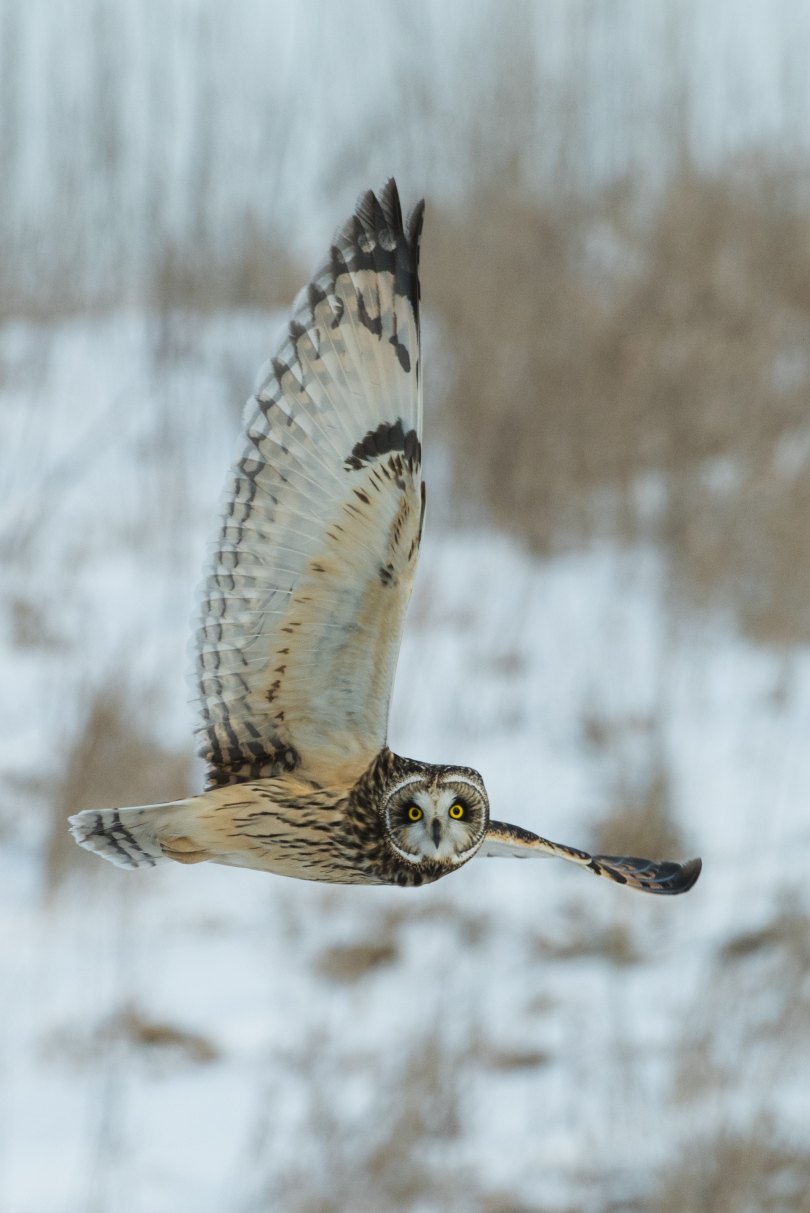
Ogni notte
il gufo
con la sua scimmiesca faccia selvaggia
lancia il suo richiamo di tra i rami neri,
e i topi hanno freddo
e i conigli rabbriviscono
nei campi innevati –
e allora si apre la lunga, profonda valle del silenzio
quando egli smette il suo canto e si lancia
in aria.
Io non so
quale sia della morte lo scopo
ultimo, ma penso
questo: chiunque sogni di tenere la sua
vita in pugno
anno dopo anno per centinaia di anni
non ha mai considerato il gufo –
come egli viene, esausto,
attraverso la neve,
attraverso gli alberi ibernati,
superati tronchi e piante,
tirandosi fuori da stalle e campanili,
girando per questa e quella via
attraverso le maglie di qualunque ostacolo –
fermato da nulla –
riempiendosi momento dopo momento
di una gioia rossa e digeribile,
lanciandosi a falce dai campi solitari e bianchi –
e come al mattino,
come se ogni cosa fosse
come deve essere, i campi
si fanno intensi di luce rosa,
il gufo scompare
allontanandosi tra i rami,
la neve va a cadere
fiocco dopo perfetto fiocco.

Lonely, White Fields

Every night
the owl
with his wild monkey-face
calls through the black branches,
and the mice freeze
and the rabbits shiver
in the snowy fields-
and then there is the long, deep trough of silence
when he stops singing, and steps
into the air.
I don’t know
what death’s ultimate
purpose is, but I think
this: whoever dreams of holding his
life in his fist
year after year into the hundreds of years
has never considered the owl-
how he comes, exhausted,
through the snow,
through the icy trees,
past snags and vines, wheeling
out of barns and church steeples,
turning this way and that way
through the mesh of every obstacle-
undeterred by anything-
filling himself time and time again
with a red and digestible joy
sickled up from the lonely, white fields-
and how at daybreak,
as though everything had been done
that must be done, the fields
swell with a rosy light,
the owl fades
back into the branches,
the snow goes on falling
flake after perfect flake.

Abolissimo il gelo, Emily Dickinson

Abolissimo il Gelo
L’Estate non cesserebbe –
Se le Stagioni periscano o prevalgano
È opzione che dipende da Noi –

(Traduzione di Giuseppe Ierolli)

Did We abolish Frost

Did We abolish Frost
The Summer would not cease –
If Seasons perish or prevail
Is optional with Us –

Sempre alla ricerca del meglio, da “Orientarsi con le stelle”, Raymond Carver

Ora che sarai fuori per cinque giorni
fumerò tutte le sigarette che vorrò,
dove vorrò. Farò i biscotti e me li mangerò
con marmellata e grasso di pancetta. Poltrirò. Mi concederò
di tutto. Passeggerò sulla spiaggia se ne avrò
voglia. E ne ho voglia, da solo
a pensare a quando ero giovane. Alle persone
che allora mi amavano alla follia.
E a come le amavo anch’io più di ogni altra.
Tranne una. Ti giuro che farò tutto
quel che voglio mentre sarai fuori!
Ma c’è una cosa che non farò.
Non dormirò nel nostro letto senza di te.
No. Non mi fa piacere farlo.
Dormirò dove cavolo mi pare…
dove dormo meglio quando sei fuori
e non ti posso abbracciare come faccio.
Sul divano rotto del mio studio.

(Traduzione di Riccardo Duranti e Francesco Durante)

Still Looking Out for Number One

Now that you’ve gone away for five days,
I’ll smoke all the cigarettes I want,
where I want. Make biscuits and eat them
with jam and fat bacon. Loaf. Indulge
myself. Walk on the beach if I feel
like it. And I feel like it, alone and
thinking about when I was young. The people
then who loved me beyond reason.
And how I loved them above all others.
Except one. I’m saying I’ll do everything
I want here while you’re away!
But there’s one thing I won’t do.
I won’t sleep in our bed without you.
No. It doesn’t please me to do so.
I’ll sleep where I damn well feel like it –
where I sleep best when you’re away
and I can’t hold you the way I do.
On the broken sofa in my study.

Pioggia, da “Mockingbird Wish Me Luck” (1972), Charles Bukowski

un’orchestra sinfonica.
scoppia un temporale,
stanno suonando un’overture di Wagner
la gente lascia i posti sotto gli alberi
e si precipita nel padiglione
le donne ridendo, gli uomini ostentatamente calmi,
sigarette bagnate che si buttano via,
Wagner continua a suonare, e poi sono tutti
al coperto. vengono persino gli uccelli dagli alberi
ed entrano nel padiglione e poi c’è la Rapsodia
Ungherese n. 2 di Liszt, e piove ancora, ma guarda,
un uomo seduto sotto la pioggia
in ascolto. il pubblico lo nota. si voltano
a guardare. l’orchestra bada agli affari
suoi. l’uomo siede nella notte nella pioggia,
in ascolto. deve avere qualcosa che non va,
no?
è venuto a sentire
la musica.

Rain

a symphony orchestra.
there is a thunderstorm,
they are playing a Wagner overture
and the people leave their seats under the trees
and run inside to the pavilion
the women giggling, the men pretending calm,
wet cigarettes being thrown away,
Wagner plays on, and then they are all under the
pavilion. the birds even come in from the trees
and enter the pavilion and then it is the Hungarian
Rhapsody #2 by Lizst, and it still rains, but look,
one man sits alone in the rain
listening. the audience notices him. they turn
and look. the orchestra goes about its
business. the man sits in the night in the rain,
listening. there is something wrong with him,
isn’t there?
he came to hear the
music.

_______________________________________

Richard Wagner: Prelude to «Lohengrin», Sir Simon Rattle

Le tre parole più strane, da “Attimo”, Wislawa Szymborska

Quando pronuncio la parola Futuro
la prima sillaba va già nel passato.

Quando pronuncio la parola Silenzio,
lo distruggo.

Quando pronuncio la parola Niente,
creo qualche cosa che non entra in alcun nulla.

(Traduzione di Pietro Marchesani)

The Three Oddest Words

When I pronounce the word Future,
the first syllable already belongs to the past.

When I pronounce the word Silence,
I destroy it.

When I pronounce the word Nothing,
I make something no nonbeing can hold.

(Translated from Polish by Stanislaw Baranczak and Clare Cavanagh)

Casalinga, Anne Sexton

Certe donne sposano una casa.
Altra pelle, altro cuore
altra bocca, altro fegato
altra peristalsi.
Altre pareti:
Incarnato stabilmente roseo.
Guarda come sta carponi tutto il giorno
a strofinar per fedeltà a se stessa.
Gli uomini c’entrano per forza,
risucchiati come Giona
in questa madre ben in carne.
Una donna è sua madre.
Questo conta.

Housewife

Some women marry houses.
It’s another kind of skin; it has a heart,
a mouth, a liver and bowel movements.
The walls are permanent and pink.
See how she sits on her knees all day,
faithfully washing herself down.
Men enter by force, drawn back like Jonah
into their fleshy mothers.
A woman is her mother.
That’s the main thing.

Il volume del canto, da “Vuoto d’amore”, Alda Merini

Il volume del canto mi innamora:
come vorrei io invadere la terra
con i miei carmi e che tremasse tutta
sotto la poesia della canzone.
Io semino parole, sono accorta
seminatrice delle magre zolle
e pur qualcuno si alza ad ascoltarmi,
uno che il canto l’ha nel cuore chiuso
e che per tratti a me svolge la spola
della sua gaudente fantasia.

Le isole fortunate, Fernando Pessoa

Quale voce giunge sul suono delle onde
che non è la voce del mare?
E’ la voce di qualcuno che ci parla,
ma che, se ascoltiamo, tace,
perché si è ascoltato.

E solo se, mezzo addormentati,
senza sapere di udire, udiamo,
essa ci dice la speranza
cui, come un bambino
dormiente, dormendo sorridiamo.

Sono isole fortunate,
sono terre che non hanno sito,
ove il Re dimora aspettando.
Ma, se ci andiamo svegliando,
tace la voce, e c’è solo il mare.

(Da “Poesie scelte” Fernando Pessoa – Passigli Editori – Traduzione Luigi Panarese)

As Ilhas Afortunadas

Que voz vem no som das ondas
Que não é a voz do mar?
É a voz de alguém que nos fala,
Mas que, se escutarmos, cala,
Por ter havido escutar.

E só se, meio dormindo,
Sem saber de ouvir, ouvimos,
Que ela nos diz a esperança
A que, como uma criança
Dormente, a dormir sorrimos.

São ilhas afortunadas
São terras sem ter lugar,
Onde o Rei mora esperando.
Mas, se vamos despertando,
Cala a voz, e há só o mar.

Gli sono troppo vicina, da “Sale” (1962), Wislawa Szymborska

Gli sono troppo vicina perché mi sogni.
Non volo su di lui, non fuggo da lui
sotto le radici degli alberi. Troppo vicina.
Non con la mia voce canta il pesce nella rete.
Non dal mio dito rotola l’anello.
Sono troppo vicina. Una grande casa brucia
senza che io chiami aiuto. Troppo vicina
perché la campana suoni appesa al mio capello.
Troppo vicina per entrare come un ospite
dinanzi a cui si scostano i muri.
Mai più morirò così leggera,
così fuori dal corpo, così ignara,
come un tempo nel suo sogno. Troppo,
troppo vicina. Sento il sibilo
e vedo la squama lucente di questa parola,
immobile nell’abbraccio. Lui dorme,
più accessibile ora alla cassiera d’un circo
con un leone, vista una sola volta,
che non a me distesa al suo fianco.
Per lei ora cresce dentro di lui la valle
con foglie rossicce, chiusa da un monte innevato
nell’aria azzurra. Io sono troppo vicina
per cadergli dal cielo. Il mio grido
potrebbe solo svegliarlo. Povera,
limitata alla mia forma,
ed ero betulla, ed ero lucertola,
e uscivo dal passato e dal broccato
cangiando i colori delle pelli. E possedevo
il dono di sparire agli occhi stupiti,
ricchezza delle ricchezze. Vicina,
sono troppo vicina perché mi sogni.
Tolgo da sotto il suo capo un braccio,
intorpidito, uno sciame di spilli.
Sulla capocchia di ciascuno sono seduti,
da contare, angeli caduti.

(Traduzione di Pietro Marchesani)

I Am Too Close

I am too close for him to dream of me.
I don’t flutter over him, don’t flee him
beneath the roots of trees. I am too close.
The caught fish doesn’t sing with my voice.
The ring doesn’t roll from my finger.
I am too close. The great house is on fire
without me calling for help. Too close
for one of my hairs to turn into the rope
of the alarm bell. Too close to enter
as the guest before whom walls retreat.
I’ll never die again so lightly,
so far beyond my body, so unknowingly
as I did once in his dream. I am too close,
too close, I hear the word hiss
and see its glistening scales as I lie motionless
in his embrace. He’s sleeping,
more accessible at this moment to an usherette
he saw once in a traveling circus with one lion,
than to me, who lies at his side.
A valley now grows within him for her,
rusty-leaved, with a snowcapped mountain at one end
rising in the azure air. I am too close
to fall from that sky like a gift from heaven.
My cry could only waken him. And what
a poor gift: I, confined to my own form,
when I used to be a birch, a lizard
shedding times and satin skins
in many shimmering hues. And I possessed
the gift of vanishing before astonished eyes,
which is the riches of all. I am too close,
too close for him to dream of me.
I slip my arm from underneath his sleeping head –
it’s numb, swarming with imaginary pins.
A host of fallen angels perches on each tip,
waiting to be counted.

(Translated from Polish by Stanislaw Baranczak and Clare Cavanagh)