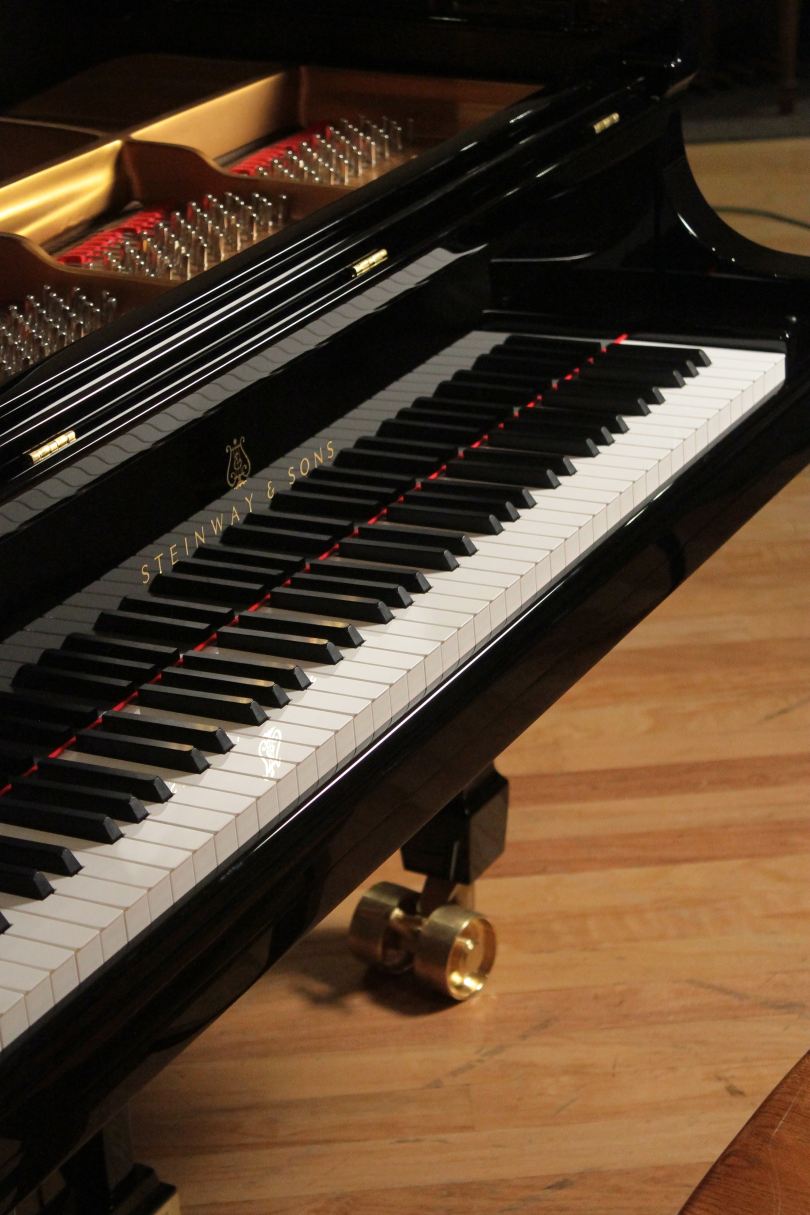
Lezioni di piano, da “A vela in solitaria intorno alla stanza” (2013), Billy Collins

1
Il mio insegnante è a terra con un brutto mal di schiena
disteso di fianco al piano.
Io sono seduto dritto sul panchetto.
Inizia dicendomi che ogni chiave
è come una diversa stanza
e io sono un cieco che deve imparare
ad attraversarle tutte e dodici
senza sbattere nei mobili.
Mi sembra di allungare la mano alla prima maniglia.

2
Mi dice che ogni scala ha una forma
e che devo imparare come tenere
ciascuna mano.
A casa mi esercito ad occhi chiusi.
Do è un libro aperto.
Re è un vaso con due manici.
Sol diesis è uno stivale nero.
Mi ha le zampe di un uccello.

3
Dice che la scala è la madre degli accordi.
Riesco a vederla mentre va su e giù per la camera da letto
aspettando che i figli tornino a casa.
Sono fuori nei nightclub a sfumare e marcare
le canzoni mentre le coppie danzano lente
o si osservano dai tavoli.
Ed è così che deve essere. Dopo tutto,
l’accordo giusto può farci piangere
ma nessuno ascolta le scale,
nessuno ascolta la loro madre.

4
Sto facendo le mie scale,
gl’inni familiari dell’infanzia.
Le dita salgono la scala delle note
e scendono senza girarsi.
Chi cammina sotto questa finestra aperta
s’immagina una bambina di circa dieci anni
seduta alla tastiera con la giusta postura,
non me, scomposto, nel mio accappatoio, spettinato,
come un Horace Silver bianco.

5
Sto imparando a suonare
It Might As Well Be Spring
ma la mano sinistra preferirebbe far tintinnare
gli spiccioli nel buio della tasca
o fare un sonnellino sul bracciolo.
Devo trascinarla nella musica
come un figlio difficile e trascurato.
Questa è la vendetta di chi non può mai
tenere la penna o salutare,
e ora, di chi non può mai suonare la melodia.

6
Anche quando non suono, penso al piano.
E’ l’oggetto più grande, pesante,
e bello di questa casa.
Mi fermo sulla soglia solo per abbracciarlo con lo sguardo.
E tardi di notte me lo figuro di sotto,
questa allucinazione, ritta su tre gambe,
questo curioso animale col suo enorme sorriso alla luce della luna.

(Traduzione di Franco Nasi)

Piano Lessons

1
My teacher lies on the floor with a bad back
off to the side of the piano.
I sit up straight on the stool.
He begins by telling me that every key
is like a different room
and I am a blind man who must learn
to walk through all twelve of them
without hitting the furniture.
I feel myself reach for the first doorknob.

2
He tells me that every scale has a shape
and I have to learn how to hold
each one in my hands.
At home I practice with my eyes closed.
C is an open book.
D is a vase with two handles.
G flat is a black boot.
E has the legs of a bird.

3
He says the scale is the mother of the chords.
I can see her pacing the bedroom floor
waiting for her children to come home.
They are out at nightclubs shading and lighting
all the songs while couples dance slowly
or stare at one another across tables.
This is the way it must be. After all,
just the right chord can bring you to tears
but no one listens to the scales,
no one listens to their mother.

4
I am doing my scales,
the familiar anthems of childhood.
My fingers climb the ladder of notes
and come back down without turning around.
Anyone walking under this open window
would picture a girl of about ten
sitting at the keyboard with perfect posture,
not me slumped over in my bathrobe, disheveled,
like a white Horace Silver.

5
I am learning to play
“It Might As Well Be Spring”
but my left hand would rather be jingling
the change in the darkness of my pocket
or taking a nap on an armrest.
I have to drag him in to the music
like a difficult and neglected child.
This is the revenge of the one who never gets
to hold the pen or wave good-bye,
and now, who never gets to play the melody.

6
Even when I am not playing, I think about the piano.
It is the largest, heaviest,
and most beautiful object in this house.
I pause in the doorway just to take it all in.
And late at night I picture it downstairs,
this hallucination standing on three legs,
this curious beast with its enormous moonlit smile.

_________________________________

Maksim Mrvica plays Pirates of the Caribbean — Live at Mercedes-Benz Arena, Shanghai
La terra perduta, Ella Wheeler Wilcox

C’è una storia di una terra meravigliosa,
dove i campi erano fertili e dove i fiori erano luminosi;
Dove alte torri brillavano nella luce del mattino,
Dove bambini felici vagavano mano nella mano,
Dove gli amanti scrivevano i loro nomi sulla sabbia.
Dicono che svanì da ogni vista umana,
il mare affamato la divorò in una notte.

Dubiti della storia? ah, capirai;
Poiché, mentre gli uomini riflettono su quella vecchia favola,
danno sempre triste credito alla fine,
nonostante abbiano cavillato sulla sua verità,
quando con una visione offuscata dalle lacrime vedono,
affondando rapidamente nell’oceano del passato,
la bella Atlantide perduta della loro giovinezza.

The Lost Land

There is a story of a beauteous land,
Where fields were fertile and where flowers were bright;
Where tall towers glistened in the morning light,
Where happy children wandered hand in hand,
Where lovers wrote their names upon the sand.
They say it vanished from all human sight,
The hungry sea devoured it in a night.

You doubt the tale? ah, you will understand;
For, as men muse upon that fable old,
They give sad credence always at the last,
However they have cavilled at its truth,
When with a tear-dimmed vision they behold,
Swift sinking in the ocean of the Past,
The lovely lost Atlantis of their Youth.

“Poetical works of Ella Wheeler Wilcox” by Ella Wheeler Wilcox
Edinburgh : W. P. Nimmo, Hay, & Mitchell, 1917

________________________________________

Lang Lang spielt Beethovens fünftes Klavierkonzert op. 73 in Es-Dur. Es folgt eine vierhändige Zugabe mit dem Dirigenten Christoph Eschenbach
Schleswig Holstein Musik Festival, Abschlusskonzert 2012 aus der Sparkassen-Arena, Kiel 

________________________________________

Lang Lang & Eschenbach — Debussy:Petite Suite En  Bateau –  Petite Suite Ballet (5:00)


Cerca la tua anima, Emily Dickinson

Cerca la tua anima
come un musicista i tasti
prima di suonare forte –
ti stordisce poco per volta –
prepara la tua natura fragile
per l’eterea botta
con martelli più deboli – uditi lontano –
poi più vicini – poi così lenti
il tuo fiato – ha tempo di riprendersi –
il cervello – di gorgogliare tranquillo –
cala – imperiale – una sola saetta –
che scalpa la tua anima nuda –

Quando i venti prendono le foreste nelle zampe –
l’universo – è fermo –

(Traduzione di Massimo Bacigalupo)

He fumbles at your Soul

He fumbles at your Soul
As Players at the Keys
Before they drop full Music on —
He stuns you by degrees —
Prepares your brittle Nature
For the Ethereal Blow
By fainter Hammers — further heard —
Then nearer — Then so slow
Your Breath has time to straighten —
Your Brain — to bubble Cool —
Deals — One — imperial — Thunderbolt —
That scalps your naked Soul —

When Winds take Forests in their Paws —
The Universe — is still —

___________________________

Valentina Babor “Children” live aus der Waldbühne, Berlin

Alla musica, da “Poesie sparse” (1953), Rainer Maria Rilke

Musica: respiro delle statue. Forse:
silenzio delle immagini. Tu lingua ove le lingue
cessano. Tempo a picco sul corso
dei cuori che passano.

Sentimenti per chi? Tu metamorfosi
dei sentimenti in che? -: in paesaggio udibile.
Musica: Tu straniera. Tu spazio del cuore
cresciuto oltre di noi. Tu a noi il più intimo
che, superandoci, di là da noi trabocca –
sacro addio:
poiché il nostro Intimo ci sta intorno come
la più frequentata lontananza, come altra
faccia dell’aria:
pura,
immensa,
non più abitabile.

(Traduzione di Giacomo Cacciapaglia) 

An die Musik

Musik: Atem der Statuen. Vielleicht:
Stille der Bilder. Du Sprache wo Sprachen
enden. Du Zeit
die senkrecht steht auf der Richtung
vergehender Herzen.

Gefühle zu wem? O du der Gefühle
Wandlung in was?— in hörbare Landschaft.
Du Fremde: Musik. Du uns entwachsener
Herzraum. Innigstes unser,
das, uns übersteigend, hinausdrängt,—
heiliger Abschied:
da uns das Innre umsteht
als geübteste Ferne, als andre
Seite der Luft:
rein,
riesig
nicht mehr bewohnbar.

To Music

Music: breathing of statues. Perhaps:
silence of paintings. You language where all language
ends. You time
standing vertically on the motion of mortal hearts.

Feelings for whom? O you the transformation
of feelings into what?–: into audible landscape.
You stranger: music. You heart-space
grown out of us. The deepest space in us,
which, rising above us, forces its way out,–
holy departure:
when the innermost point in us stands
outside, as the most practiced distance, as the other
side of the air:
pure,
boundless,
no longer habitable.

Translated by Stephen Mitchell

________________________________________

David Garrett – Niccolo Paganini, La Campanella Opus 7, Live

_________________________________________

David Garrett – Music 2013 – Original by John Miles 1976

Last Night the Rain Spoke to Me, from “What Do We Know: Poems and Prose Poems” (2003), Mary Oliver

Last night
the rain
spoke to me
slowly, saying,

what joy
to come falling
out of the brisk cloud,
to be happy again

in a new way
on the earth!
That’s what it said
as it dropped,

smelling of iron,
and vanished
like a dream of the ocean
into the branches

and the grass below.
Then it was over.
The sky cleared.
I was standing

under a tree.
The tree was a tree
with happy leaves,
and I was myself,

and there were stars in the sky
that were also themselves
at the moment
at which moment

my right hand
was holding my left hand
which was holding the tree
which was filled with stars

and the soft rain—
imagine! imagine!
the long and wondrous journeys
still to be ours.

_______________________________

Valentina Babor – When the rain begins to fall 2015
Original von Jermaine Jackson und Pia Zadora 1984

I venti del sud li spingono -, Emily Dickinson

I venti del sud li spingono –
I bombi arrivano –
Volteggiano – esitanti –
Bevono, e se ne vanno –
Le farfalle sostano
Nel loro passaggio di Cachemire –
Io – strappando dolcemente,
Qui li offro!

(Traduzione di Giuseppe Ierolli)

South winds jostle them –

South winds jostle them –
Bumblebees come –
Hover – hesitate –
Drink, and are gone –
Butterflies pause
On their passage Cashmere –
I – softly plucking,
Present them here!

___________________________

David Garrett -The Flight Of The Bumble Bee (HD)

Rumori dell’estate, da “Dal mare o da altra stella” (2006), Eugénio De Andrade

Le cicale cantano
come d’inverno
arde la legna verde.

Un rumore puerile
e dolce di api
aggiunge la sete.

Quando il sole avvista
i fianchi del mare
si spoglia di corsa,

e danza danza danza.

(Traduzione di Federico Bertolazzi)

Rumores do verão

As cigarras cantam
como no inverno
arde a lenha verde.

Um rumor pueril
e doce de abelhas
acrescenta a sede.

Quando o sol avista
os flancos do mar
despe-se a correr,

e dança dança dança.

____________________________

Mari Samuelsen: Vivaldi – “Summer” from Four Seasons

Due parole, da “L’altro sguardo” (1999), Alfonsina Storni

Questa notte all’orecchio m’hai detto due parole
comuni. Due parole stanche
d’essere dette. Parole
così vecchie da essere nuove.

Parole così dolci che la luna che andava
trapelando dai rami
mi si fermò alla bocca. Così dolci parole
che una formica passa sul mio collo e non oso
muovermi per cacciarla.

Così dolci parole
che, senza voler, dico: “Com’è bella la vita!”
Così dolci e miti
che il mio corpo è asperso di oli profumati.

Così dolci e belle
che, nervose, le dita
si levano al cielo sforbiciando.

Oh, le dita vorrebbero
recidere stelle.

(Traduzione di Angelo Zanon Dal Bo)

Dos palabras

Esta noche al oído me has dicho dos palabras
comunes. Dos palabras cansadas
de ser dichas. Palabras
que de viejas son nuevas.

Dos palabras tan dulces que la luna que andaba
filtrando entre las ramas
se detuvo en mi boca. Tan dulces dos palabras
que una hormiga pasea por mi cuello y no intento
moverme para echarla.

Tan dulces dos palabras
que digo sin quererlo -¡oh, qué bella, la vida!-
Tan dulces y tan mansas
que aceites olorosos sobre el cuerpo derraman.

Tan dulces y tan bellas
que nerviosos, mis dedos,
se mueven hacia el cielo imitando tijeras.
Oh, mis dedos quisieran
cortar estrellas.

Two Words

Tonight at my ear
you have said two simple words.
Two words tired of being said.
Words so old they are new.

Two such sweet words
that the moon dripping through the branches
lands in my mouth. So sweet
these two words that I let an ant
wander down my neck without moving.

Such sweet two words that I say
without trying-How beautiful life is!
So sweet, so tame,
they spill like aromatic oils on my body.

So sweet and so beautiful
that my nervous fingers
move toward the sky like scissors
wanting to cut out the stars.

_______________________________

Martynas Levickis plays Astor Piazzolla’s Libertango with the Seoripul Symphony Orchestra conducted by Je Hi Park, Seoul

No, non è una parola, da “Gli amorosi incanti” (2010), Sara Teasdale

Oh no che non è una parola,
ben poco da dire ci resta:
e non è nemmeno una sola
occhiata, né un cenno di testa.

E’ solo un silenzio del cuore
che ha un carico troppo pesante,
è solo il risveglio di tante
memorie dal tenue sopore.

(Traduzione di Silvio Raffo)

“It Is Not A Word”

It is not a word spoken,
Few words are said;
Nor even a look of the eyes
Nor a bend of the head,
But only a hush of the heart
That has too much to keep,
Only memories waking
That sleep so light a sleep.

_______________________________

Martynas Levickis – Shallow (A Star Is Born) feat Ignė Pikalavičiūtė & Mikroorkéstra

Sonetto americano, da “A vela in solitaria intorno alla stanza” (2013), Billy Collins

Non parliamo come Petrarca né portiamo un cappello come Spenser
e non sono quattordici versi
come solchi in un campicello arato con cura,

ma è la cartolina, una poesia sulla vacanza,
che ci costringe a cantare le nostre canzoni in piccole stanze,
o a versare i nostri sentimenti in misurini.

Scriviamo sul retro di laghi o cascate,
e aggiungiamo al paesaggio una didascalia convenzionale
come gli occhi eliocentrici di una donna elisabettiana.

Localizziamo un aggettivo per il tempo.
Annunciamo che ci stiamo divertendo un mondo.
Esprimiamo il desiderio che tu sia qui

e nascondiamo il desiderio di essere dove sei tu,
che vai verso casa dalla cassetta postale, la testa abbassata,
leggendo e rigirando fra le mani il messaggio sottile.

Una fetta di questo posto, un tratto di spiaggia bianca,
una piazza o le guglie scolpite di una cattedrale
si insinueranno nel luogo familiare in cui sei,

e lancerai sulla tavola questo campione a due facce:
qualche centimetro quadrato di dove siamo capitati,
e un condensato di quel che sentiamo.

(Traduzione di Franco Nasi)

American Sonnet

We do not speak like Petrarch or wear a hat like Spenser
and it is not fourteen lines
like furrows in a small, carefully plowed field

bu the picture postcard, a poem on vacation,
that forces us to sing our songs in little rooms
or pour our sentiments into measuring cups.

We write on the back of a waterfall or lake,
adding to the view a caption as conventional
as an Elizabethan woman’s heliocentric eyes.

We locate an adjective for the weather.
We announce that we are having a wonderful time.
We express the wish that you were here

and hide the wish that we were where you are,
walking back from the mailbox, your head lowered
as you read and turn the thing message in your hands.

A slice of this place, a length of white beach,
a piazza or carved spires of a cathedral
will pierce the familiar place where you remain,

and you will toss on the table this reversible display:
a few square inches of where we have strayed
and a compression of what we feel.

____________________________________

Hauser & Caroline Campbell: Torna a Surriento
Gala Concert at Arena Pula 2018